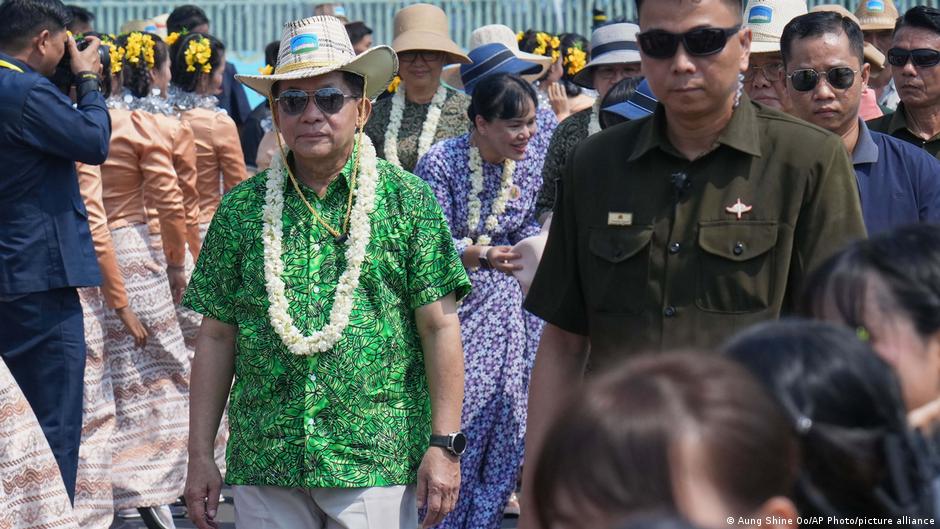
The US government has begun a quiet reproachment with Myanmar's military-backed government, holding two rounds of talks since September, with State Department representative Michael Vance reportedly meeting Myanmar officials in Naypyitaw and then in Tokyo earlier this month. Washington wants to tackle online scam centers, secure the release of an imprisoned American businessman Adam Castillo, and potentially gain access to Myanmar's rare-earth resources. The market for the valuable minerals is currently controlled by the US rival China.
Meanwhile, Southeast Asian governments are also increasingly questioning their policy of isolating Myanmar's military leadership, and multiple countries have already renewed direct diplomatic contacts. The EU, however, continues to reject the legitimacy of the military junta in the war-torn country. The European bloc has also remained unmoved by the 2025/2026 election which ended with military chief Min Aung Hlaing becoming the president.
The military retains control over the political system. To view this video please enable JavaScript, and consider upgrading to a web browser that supports HTML5 video The EU responded to Myanmar's February 2021 military coup by suspending direct financial assistance to the government, imposing targeted sanctions and sharply reducing diplomatic engagement with the military authorities. Its sanctions currently cover 105 individuals and 22 entities connected to the military.
In April, the EU extended these measures for another 12 months. At the same time, Brussels is providing humanitarian assistance to displaced communities and Rohingya refugees and is supporting civil society organizations. The EU also stopped short of withdrawing Myanmar's preferential trade access because of concerns about the consequences for workers, particularly the mostly young women employed in the country's garment industry.
Last year, bilateral goods trade was worth about €4 billion ($4.46 billion), up from €3.4 billion in 2019. The civil war triggered by the 2021 coup has killed an estimated 100,000 people. Rebel groups still control or contest large swathes of Myanmar, and over 4 million people have been internally displaced, according to UN data.
The EU "continues to uphold its policy of non-recognition of the current military regime," in view of "the ongoing violence and the attack against its own population," an EU spokesman told DW. At the same time, the bloc "is closely monitoring developments in the discussions and positions of the United States, Japan, ASEAN countries and other major actors with representatives of Myanmar's military regime." "It also supports ASEAN efforts, in particular the Five-Point Consensus, which has yet to be fully implemented," the spokesperson added, referring to the peace deal proposed by the Association of Southeast Asian Nations (ASEAN) in 2021. In the aftermath of the coup, ASEAN took the unprecedented decision to exclude Myanmar's military leaders from its highest-level meetings after the junta failed to implement the regional peace plan.
Extract — continue reading at the source.