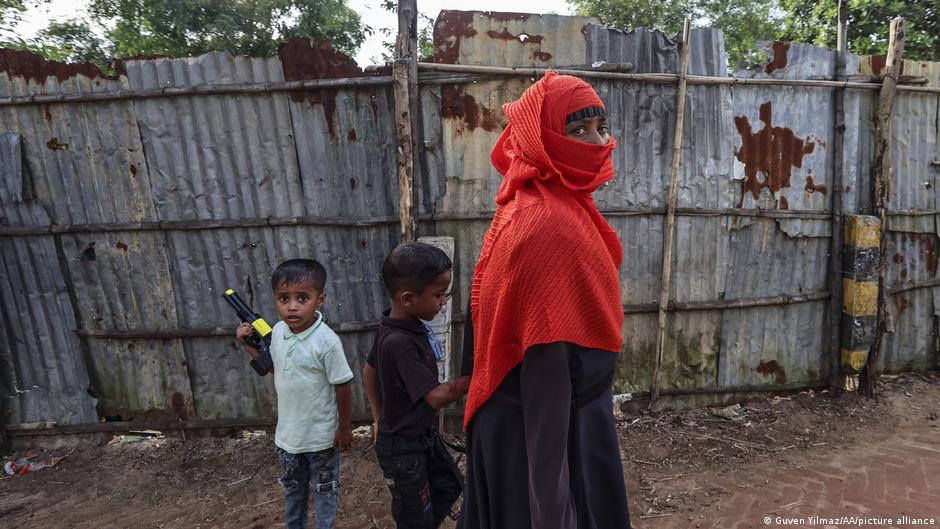
Myanmar's military-backed government is again talking about bringing Rohingya refugees home from refugee camps in neighboring Bangladesh. Earlier this month, authorities in Naypyidaw, Myanmar's capital, said they had made progress verifying Rohingya refugees in Bangladesh for possible repatriation. Of the 820,000 names submitted by Bangladesh, Myanmar said it had verified around 308,000 as former residents but would not repatriate them until security conditions improve in civil war-torn Rakhine State.
But analysts told DW that large-scale, safe repatriation is now arguably further out of reach than at any point since 2017. Myanmar is engulfed in civil war, the military no longer controls most of Rakhine state, and the Rohingya remain denied citizenship. In August 2017, Myanmar's military launched sweeping operations in northern Rakhine state after alleged attacks by the Arakan Rohingya Salvation Army (ARSA) militant group on security posts.
More than 750,000 Rohingya, a long-persecuted Muslim ethnic minority in predominantly Buddhist Myanmar, fled to Bangladesh, joining hundreds of thousands displaced by earlier crackdowns. Muslim-majority Bangladesh now hosts around 1.2 million Rohingya refugees, mostly in camps around the southern coastal district of Cox's Bazar, according to UN bodies. Myanmar does not recognize the Rohingya as one of its 135 officially recognized ethnic groups and has long referred to them as "Bengalis," implying they are migrants from Bangladesh despite generations of Rohingya having lived in Rakhine.
UN investigators found evidence of genocidal intent by Myanmar's military, while the United States argued in 2022 that members of the military had committed genocide and crimes against humanity against the Rohingya. A genocide case brought by the West African nation of Gambia against Myanmar remains before the International Court of Justice in The Hague. Myanmar's 2021 coup triggered a nationwide civil war that is still raging, even after a much-criticized election earlier this year saw the formation of a civilian government, which remains dominated by officials from the military and junta.
"Safe repatriation is simply not possible," Ronan Lee, a researcher at Loughborough University and author of the 2021 book "Myanmar's Rohingya Genocide," told DW. There is a civil war in Myanmar and the economy has collapsed, Lee said, meaning a return under present conditions would carry a high risk of the Rohingya again facing violence from the military. "Myanmar's government is dominated by the same military that genocidally deported the Rohingya in 2017," Lee added.
"Life in Myanmar today would be more dangerous for the Rohingya than when they were forcibly deported in 2017." Moe Thuzar, head of the Myanmar Studies Program at Singapore's ISEAS-Yusof Ishak Institute, agreed that repatriation is much less realistic today than at any point since 2017. Even if Myanmar's military-backed authorities wanted to facilitate returns, which few analysts think they do, they no longer control most of Rakhine, Thuzar noted. The Rakhine-based ethnic Arakan Army, an ethnic Rakhine armed group distinct from the Rohingya insurgent group ARSA, now controls much of the state, including northern areas from which many Rohingya fled.
Extract — continue reading at the source.