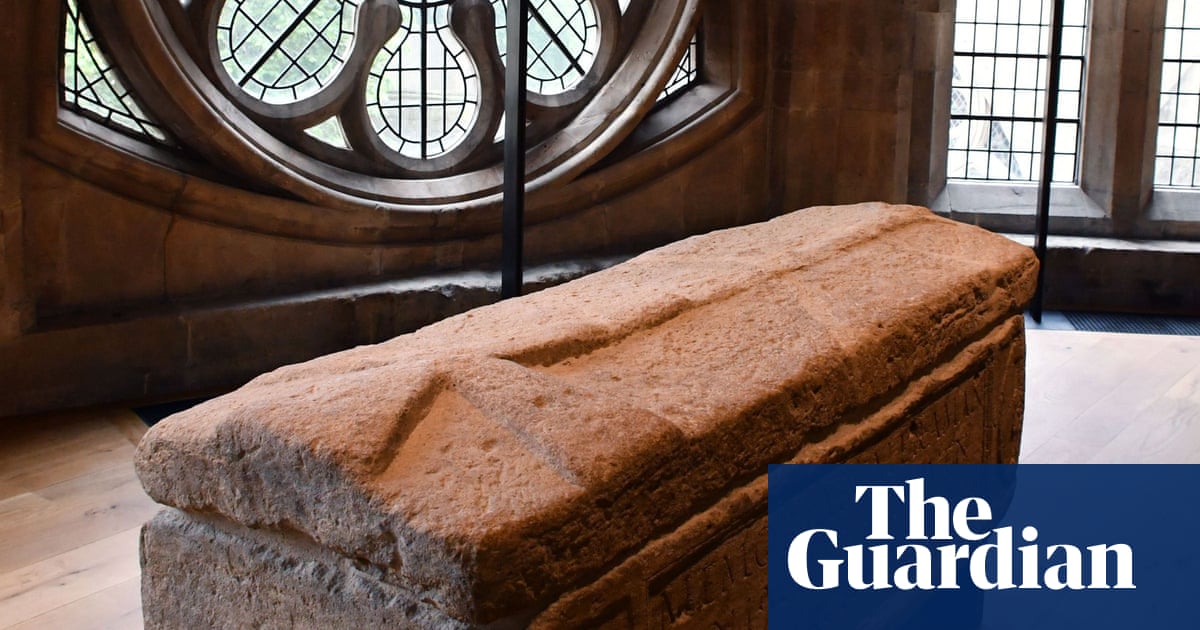
It has all the ingredients of a chilling mystery: the skeleton of an unknown man discovered within a Roman sarcophagus unearthed in the grounds of Westminster Abbey. Now an expert has said he has solved the longstanding “who-is-it”, suggesting the remains belonged to a medieval abbot. First discovered in 1820, the limestone sarcophagus was officially excavated in 1869 from what is now an area of grass along the north side of the nave, but was once the yard of a sacristy built by Henry III.
But the discovery spawned a mystery: whose remains were inside? While the sarcophagus itself was from the late Roman period, with a Latin inscription to one Valerius Amandinus and Roman decoration on one side, no Roman artefacts were found in subsequent excavations of the area. What’s more, the lid of the fourth-century sarcophagus was decorated with a large, carved cross that was later shown to be a modification of the original lid.
Writing in the Journal of the British Archaeological Association, Rodwell not only describes what was previously known about the sarcophagus but sets out the findings of a more recent investigation in 2018 as part of plans to display the sarcophagus in the Queen’s Diamond Jubilee Galleries. As part of that work the sarcophagus was taken to a laboratory and its lid removed. The discovery was something of a surprise given written records had suggested the skeleton had been lost.
However, Rodwell said the bones tallied with those depicted in 19th-century drawings. A subsequent analysis suggested the remains belonged to a man who was 5ft 9in tall and aged between 35 and 49. In another twist, when the inside of the sarcophagus was cleaned, experts found a rectangular outline in a white substance in the bottom of the sarcophagus.
Rodwell said this suggests the body had been covered in powdered lime before being placed into a wooden coffin that sat inside the sarcophagus. Crucially, radiocarbon dating of the bones suggested they were from the late 10th or early 11th century. Now Rodwell said he had the answer to the identity of the dead man, suggesting it was most likely a medieval abbott.
Rodwell believes Ælfwig is the most likely candidate, noting he was already a monk at Westminster when the previous abbot died, and spent about 27 years in the role. Rodwell suggested the re-used sarcophagus was most likely interred in the eastern arm of the abbey church, with the lid as a floor slab, before being dug up and reburied during the construction work of Henry III.
Extract — continue reading at the source.