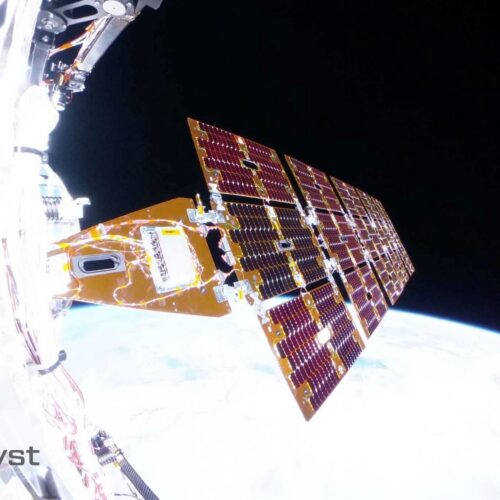
NASA and Katalyst Space Technologies announced Wednesday they are giving up on a robotic mission to rescue the Swift gamma-ray telescope before it falls out of orbit. The rescue satellite, named Link, launched July 3 on a journey to fly up to NASA’s Neil Gehrels Swift Observatory, capture it with three robotic arms, and boost its orbit high enough to escape a looming reentry. Link is about the size of a refrigerator, with two power-generating solar arrays and three xenon-fueled electric thrusters to send Swift into a safer, higher orbit.
Katalyst, the startup leading the Swift rescue effort, said Wednesday that “ongoing attitude control issues” will prevent the Link satellite from completing its rescue mission. The spacecraft is still alive, and Katalyst said it will make the most of Link’s remaining capacity, which may still allow it to get near enough to Swift for a demonstration of the satellite’s close-in navigation system. NASA awarded Katalyst a $30 million contract less than a year ago to build and launch the Link satellite.
NASA said Katalyst had to launch the rescue mission by this summer in order to reach Swift before it falls back into Earth’s atmosphere and burns up. It usually takes several years to ready a first-of-its-kind satellite for launch. Katalyst did it in nine months.
The timeline forced hard trade-offs, with the schedule driving engineers to tolerate technical risks they might not otherwise accept. Everything seemed to go well during the satellite’s first few weeks in orbit. That changed in late July when the Link spacecraft suddenly spun out of control.
Katalyst hasn’t said what caused the problem, but two of the satellite’s three reaction wheels, used for attitude control, stopped working. There were also issues with cold gas thrusters used for finer pointing control. That left the satellite’s three low-impulse plasma thrusters as the only means of regaining control of Link’s orientation as it zipped around the Earth at nearly 5 miles per second.
Extract — continue reading at the source.