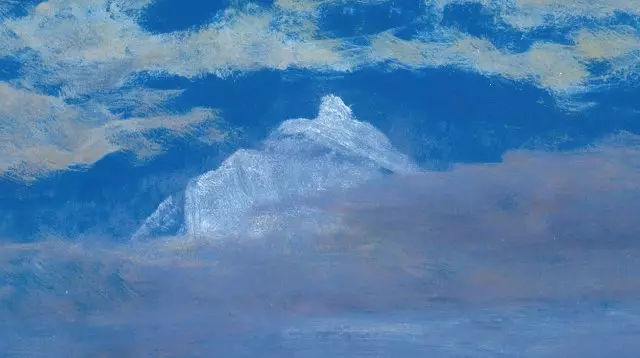
NASA’s Hubble opens the earliest window into the young Milky Way The newest find recovers the earliest merger in galactic history: just 2 billion years after the Big Bang. Here’s what we know today. This illustration shows the very young Milky Way, at right, absorbing a dwarf galaxy known as LKH: Low-energy-Kraken-Heracles, just 2 billion years after the Big Bang.
This marks likely the largest, most major merger in galactic history, as far as the mass ratios of the two galaxies at the time is concerned. The Milky Way, spanning over 100,000 light-years, is our galactic home. Among its many discoveries, the ESA’s Gaia mission has found that the Milky Way galaxy not only has a warp to its galactic disk, but that the warp in the disk precesses and wobbles, completing a full rotation for roughly every three revolutions of the Sun (in yellow) around the galactic center.
The origin of the Milky Way’s rotation is not cosmic, but rather is thought to arise from the relative gravitational and tidal forces acting on it during various stages of galaxy formation. Growing throughout cosmic history, it now possesses 400 billion stars, and 150+ globular clusters. There are slightly over 150 globular clusters identified within 200,000 light-years of the galactic center, with an additional five or six to be found if we double the radius of this search.
While most formed along with the Milky Way, a substantial fraction did not, and were brought in at later times when smaller galaxies, such as the Kraken and Gaia-Enceladus, were devoured and cannibalized. This growth required more than the steady accretion of infalling matter. One of the major ideas for how galaxies grow over cosmic time is that matter infalls, due to gravity, from the cosmic surroundings.
Meanwhile, energetic processes like star-formation, supernovae, stellar winds, and black hole jets work to expel matter. However, with enough mass, that material will persist in the outer galactic halo, cool, and fall back in, where it can participate in new episodes of star-formation. At critical moments throughout history, we swallowed other, smaller galaxies.
Zw II 96 in the constellation of Delphinus, the Dolphin, is an example of a galaxy merger located some 500 million light-years away. Star-formation is triggered by these classes of events, and can use up large amounts of gas within each of the progenitor galaxies, rather than a steady stream of low-level star formation found in isolated galaxies. Over time, smaller, lower-mass galaxies are gobbled up by their more massive galactic neighbors in acts of galactic cannibalism.
Extract — continue reading at the source.