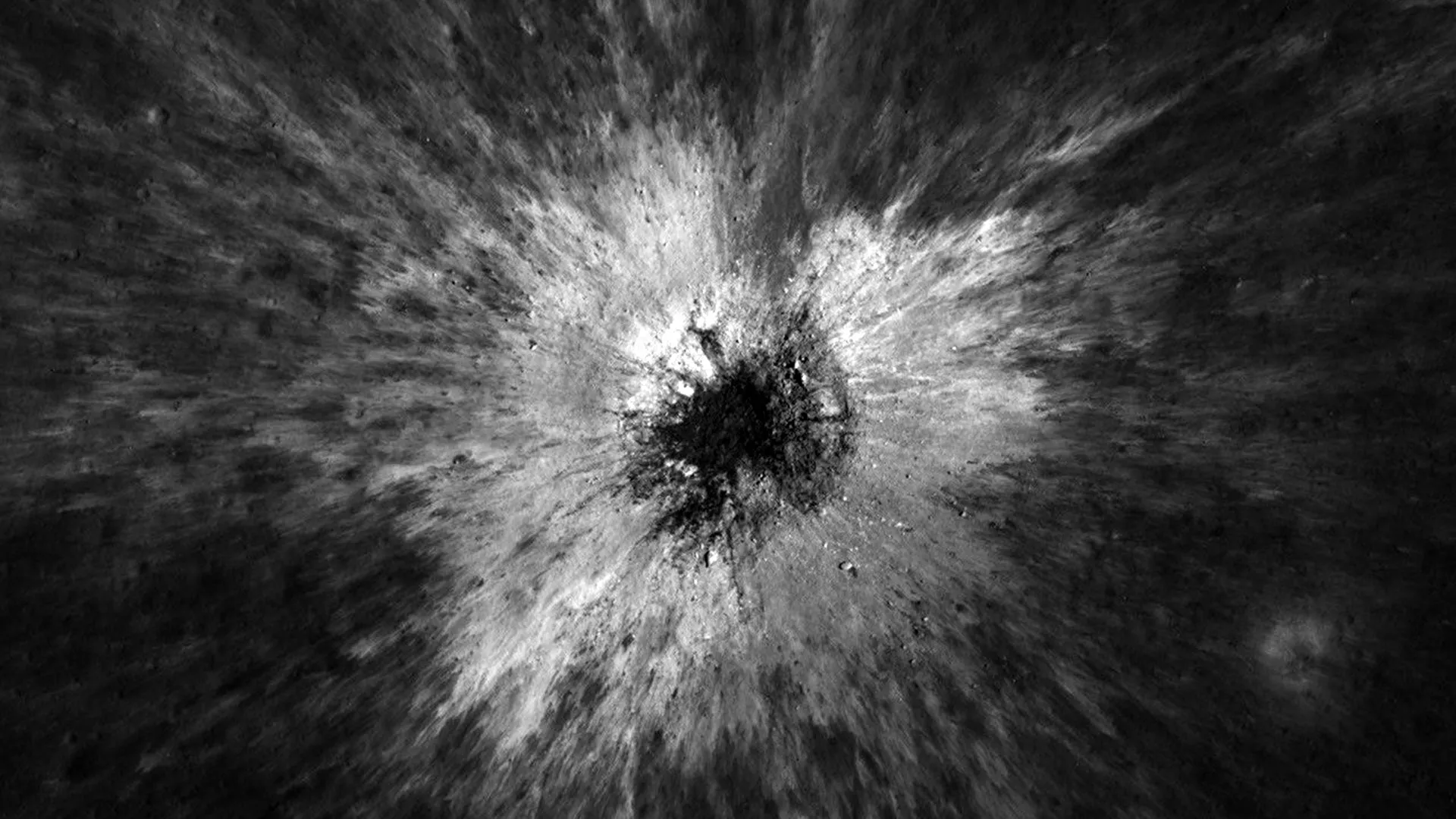
A routine check of NASA lunar data unexpectedly led to a major discovery. Robert Wagner, a scientist who works with NASA's Lunar Reconnaissance Orbiter (LRO), was examining a large map of the Moon when something unusual stood out on his computer screen. He noticed an unusually bright patch surrounded by a dark halo, a pattern suggesting that material on the lunar surface had recently been disturbed.
"I just stopped, dropped everything, and started looking into what that spot was," said Wagner, an image-processing specialist from Intuitive Machines who works with data from the Lunar Reconnaissance Orbiter Camera (LROC) system. When Wagner compared older and newer images of the same region, he realized the feature was a newly formed impact crater. Scientists reported on September 16 in Science Advances that it is the largest newly formed crater ever identified in the solar system.
The finding also demonstrates how useful NASA's long-running lunar observations are for tracking changes on the Moon as the agency works toward a sustained human presence and greater scientific and commercial activity there. A Rare Impact Creates a Giant Moon Crater The crater was officially named McGetchin in honor of pioneering lunar scientist Tom McGetchin. It formed near the Moon's eastern edge sometime between April 11 and May 22, 2024, when an asteroid or comet roughly the size of a three- to six-story building struck the surface.
The impact carved out a crater 728 feet wide, roughly the length of two football fields. At 141 feet deep, it would be large enough to hold three yellow school buses stacked vertically. Researchers estimate that an impact this large may occur on the Moon only about once every century, or even less frequently.
For more than 17 years, LRO has been circling the Moon while its seven instruments study the landscape, surface composition, temperature, and radiation environment. During that time, researchers have identified at least 1,000 new impact craters. They have also recorded about 100,000 additional changes to the surface caused either by objects striking the Moon or by debris thrown outward during impacts.
Unlike Earth, the Moon has no atmosphere capable of slowing incoming space rocks or burning them up before they reach the ground. That means asteroids, meteoroids, and other objects can strike the lunar surface directly. Most impacts are far smaller than the collision that created McGetchin.
Extract — continue reading at the source.


