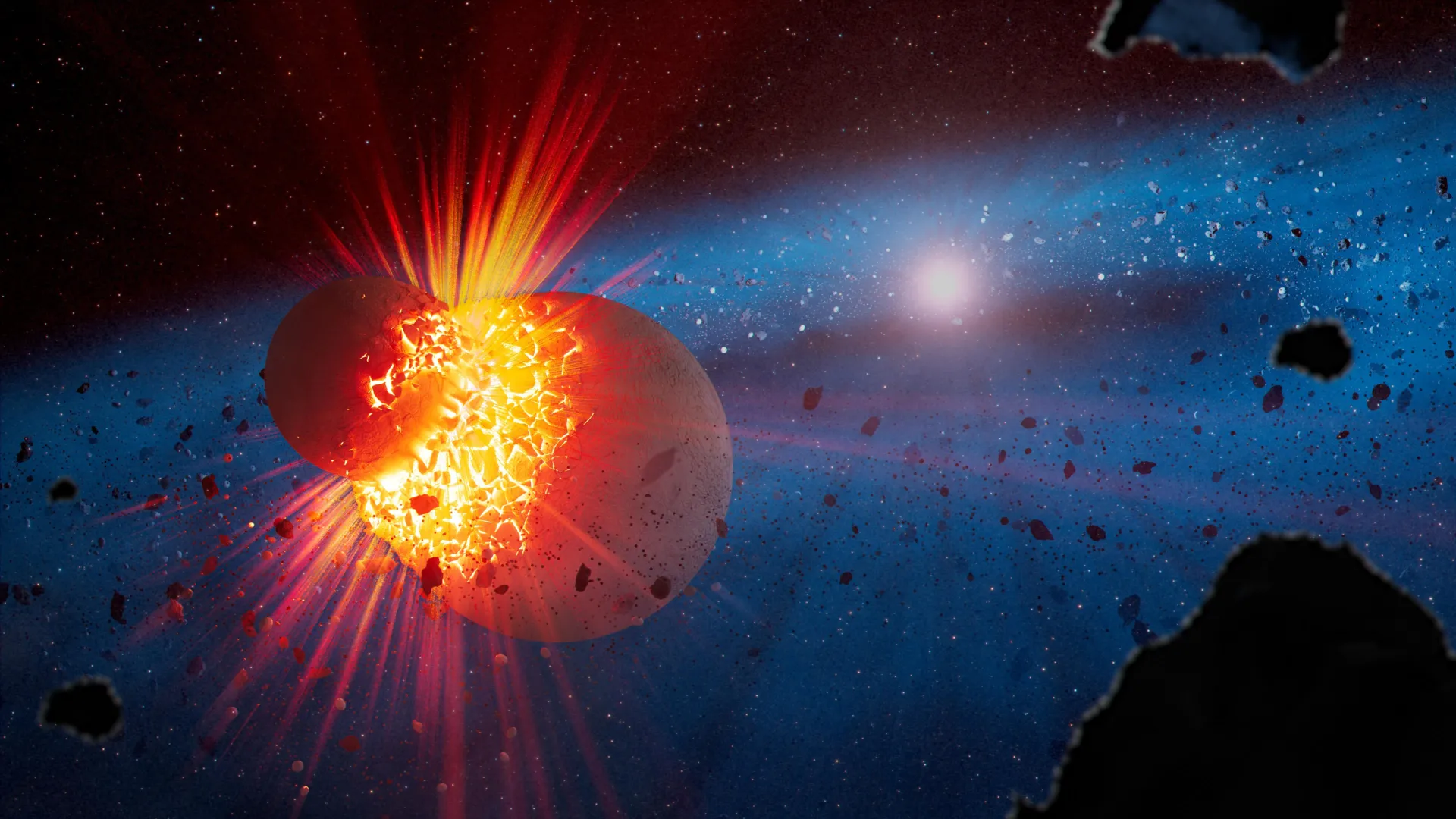
Scientists think one of the most important events in the early solar system was a colossal collision between the young Earth and a Mars-sized body known as Theia. The impact likely vaporized huge quantities of rock and hurled material into space. Some of that debris eventually came together to form the Moon, where NASA's Artemis program is returning humans, preparing for Mars, and shaping the future of space exploration.
That ancient impact dramatically altered Earth. Now, astronomers are using NASA's James Webb Space Telescope to investigate young star systems that appear to be experiencing similarly violent events. By studying these systems, researchers can estimate how energetic the collisions were and learn more about how rocky planets form and evolve.
The team's findings published Oct 1. in The Astrophysical Journal. The material surrounding a star changes significantly over time. Young stars begin with a juvenile, gas-rich protoplanetary disk where forming planets can reside.
As the system matures, that environment develops into a gas-poor debris disk. During its years of operation, NASA's retired Spitzer Space Telescope studied these debris disks and identified an unusual category known as extreme debris disks. These systems contain exceptionally large amounts of warm dust close to their stars, roughly in the same region where rocky planets orbit in our own solar system.
Kate Su of the Space Science Institute in Boulder, Colorado, led a team of astronomers that used Webb to investigate these unusual systems in greater detail. Theoretical models suggest extreme debris disks should be relatively common, but observations tell a different story. Based on data gathered so far, scientists estimate that only about 1% of young stars display observable signs of this stage.
Our own solar system may also have passed through such a phase while it was forming. Even though these systems are uncommon, the researchers assembled a sample of 21 extreme debris disks. Five came from archival Spitzer observations, and 16 were studied with Webb.
Extract — continue reading at the source.


