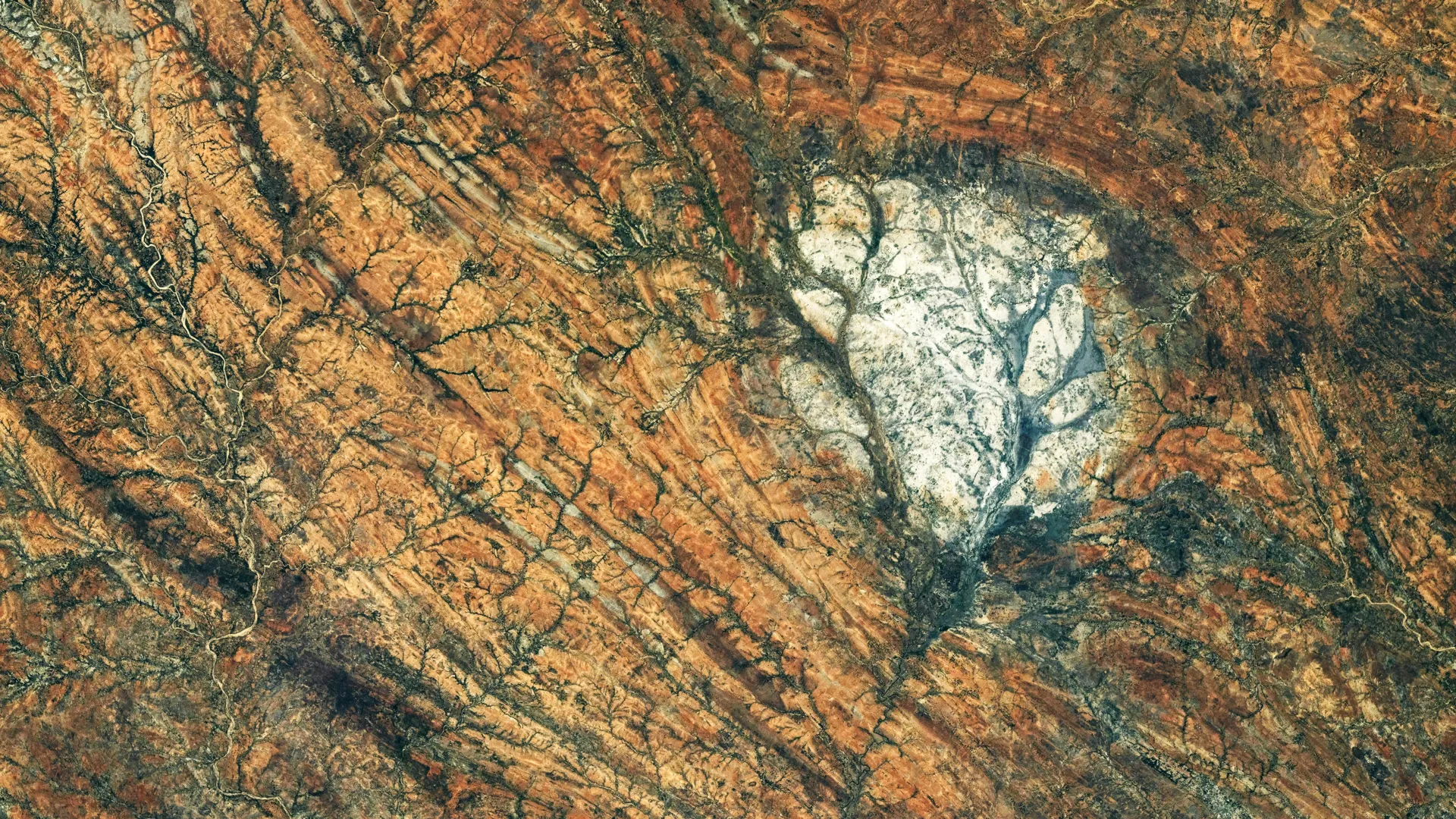
An ancient formation of bright anorthosite, a rock commonly found on the Moon, stands out among the heavily deformed rocks of southern Madagascar. A bright, unusual patch of rock in southern Madagascar has a surprising connection to the Moon. Seen from space, the formation stands out against the surrounding dry landscape.
Although it may look unusual on Earth, the same type of rock is widespread across the lunar surface. The rock, called anorthosite, is an igneous material that makes up much of the Moon's bright, reflective highlands. These light-colored regions are visible to the naked eye when looking at the Moon from Earth.
Anorthosite is not exclusive to the Moon. Large deposits also occur in several regions of Earth, including eastern Canada, Scandinavia, southern India, and Madagascar. In southern Madagascar, one particularly striking deposit forms a roughly circular feature that is easily distinguishable from the surrounding terrain.
NASA Astronaut Photographs Ancient Rock Formation On August 28, 2026, an astronaut aboard the International Space Station photographed the Saririaky anorthosite massif, a large body of rock exposed at Earth's surface. Anorthosite is classified as an intrusive igneous rock, meaning it forms when molten material cools and solidifies beneath Earth's surface. Because this cooling process takes place underground, the minerals have time to develop into relatively large crystals.
Geological research suggests that the Saririaky formation originated during the late Precambrian, at least 600 million years ago. Today, the exposed rock covers approximately 100 square kilometers (40 square miles). Although the formation is remarkable on its own, the surrounding landscape tells an equally fascinating story.
The neighboring rocks preserve evidence of enormous forces that reshaped the region hundreds of millions of years ago. Ancient Continental Collisions Reshaped Madagascar The Saririaky massif lies within what geologists call a ductile shear zone. In these regions, rocks undergo intense deformation as powerful geological forces act on them deep within Earth's crust.
Extract — continue reading at the source.


