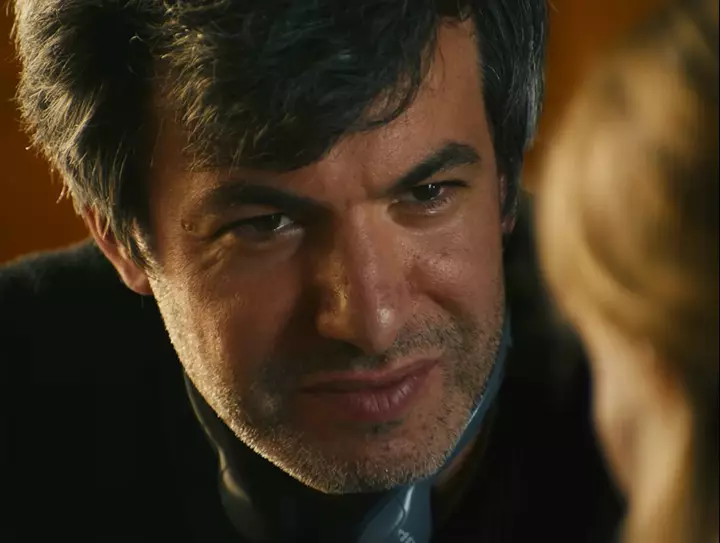
For three days, the Telluride Film Festival ran on a single unknown rumor. By Sunday night, the line outside the Werner Herzog Theatre had swelled into the longest of the weekend, phones were sealed in locked pouches, a security team worked the aisles in night-vision goggles and a Telluride programmer took the stage to warn the crowd, only half-joking, that anyone who spoiled what came next was no longer loved. Then the mystery that had consumed the mountains finally broke.
The secret screening was “You Can See Everything,” Nathan Fielder and Lance Oppenheim’s documentary about Elizabeth Holmes, and the room came apart. A24 confirmed it the same night as the movie hit play, dropping a teaser and announcing an October theatrical release, which means the guessing game is over and the awards conversation has begun. With that release date, the studio has planted a 172-minute nonfiction epic squarely in this season’s documentary feature race — and it arrives as the rare title that critics and attendees started debating immediately after the credits finished.
Thirty-four days before she reported to prison, Holmes invited a skeptical crew inside her home to record her every move. What began as a portrait of a convicted felon became a three-year descent that A24’s own logline calls a journey “into the abyss.” Hollywood has chased the Theranos saga for years — Alex Gibney’s “The Inventor” got there in 2019, Hulu’s “The Dropout” won Amanda Seyfried an Emmy and a Jennifer Lawrence vehicle from Adam McKay collapsed before it could even start shooting — but no one has approached Holmes the way these two filmmakers do. That is the first reason to take this seriously as a contender.
Fielder is the most restlessly inventive nonfiction mind in television, coming off a second season of “The Rehearsal” that earned Peabody recognition and an Emmy nomination for writing and “You Can See Everything” is his feature directing debut. Oppenheim, meanwhile, is having the festival run of his life — his first scripted feature, the Robert Pattinson thriller “Primetime,” bowed in Venice to a rapturous response — and his nonfiction pedigree (“Some Kind of Heaven,” “Ren Faire,” “Spermworld”) gives the project a formal rigor that Fielder’s persona-driven work does not always foreground. The pairing is the story.
Two artists obsessed with how the camera warps the thing it records, turned loose on the most studied liar of the century. The craft is what builds an awards case, and this one is stacked. Shot by David Bolen — the “Some Kind of Heaven” and “Thelma” cinematographer who also lensed Oppenheim’s “Primetime” — the film trades the filmmakers’ usual anamorphic gloss for a boxed-in 4:3 frame and long zoom lenses that let two operators drift through a family home like ghosts, but ones the families clearly acknowledge and want as part of their story.
Editor Adam Locke-Norton, Fielder’s collaborator of two decades, sustains conversations well past the point of comfort, letting non-answers hang in the air. And Ari Balouzian, the composer and one-third of the soul trio Gabriels, threads a noir score through the domestic footage that turns a beach house into a crime scene of the mind. In a documentary field where craft branches increasingly reward ambition, all three are legitimate below-the-line conversation starters.
Extract — continue reading at the source.