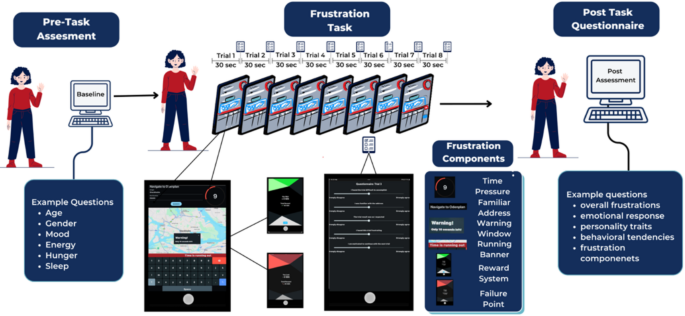
Frustration responses vary substantially across individuals, yet the psychological characteristics associated with task-evoked frustration remain unclear. We examined whether four theoretically organized psychological domains, Big Five, BIS/BAS, Self-regulation, and Self-evaluation, were associated with post-task subjective frustration following a controlled frustration-induction task. The final sample comprised 145 participants.
Hierarchical regressions with HC3-robust inference first accounted for baseline mood, energy, hunger, and sleep, followed by task-familiarity controls. Baseline-state and familiarity blocks were not significant in the primary models. When entered separately after these controls, each psychological-domain block showed a significant incremental association with frustration at the unadjusted 0.05 level.
At the individual-measure level, higher negative emotionality and behavioral inhibition were positively associated with frustration and remained significant in Cook’s-distance sensitivity analyses. No other individual psychological coefficients were significant in the primary robust models. These exploratory findings provide a focused basis for future confirmatory research on individual differences in subjective responses to goal obstruction.
Emotions can shape goal-directed behavior by influencing intentions, planning, effort, and responses to goal outcomes1. Positive affect may support continued engagement, whereas obstacles and setbacks can evoke negative affective responses such as frustration. Frustration is a negative affective response that commonly arises when goal pursuit is obstructed or when expected outcomes or rewards are not obtained2,3,4.
Individuals differ substantially in how they experience and respond to frustration. Similar obstacles may be accompanied by marked irritation or disengagement in some individuals but continued persistence in others. Such variation motivates examination of personality, motivational sensitivity, and self-regulatory capacity as potential correlates of frustration.
The present study examined whether selected personality, motivational, self-regulatory, and self-evaluative measures were associated with post-task subjective frustration following the Frustration Induction Task, a controlled task designed to elicit frustration5. The classic frustration-aggression hypothesis linked interference with expected goal attainment to aggression, whereas later reformulations proposed that frustration increases aggressive inclinations insofar as goal obstruction evokes negative affect3,4. More broadly, frustration arises within goal pursuit when motivation to obtain an outcome is met by obstruction or nonreward6.
Extract — continue reading at the source.


