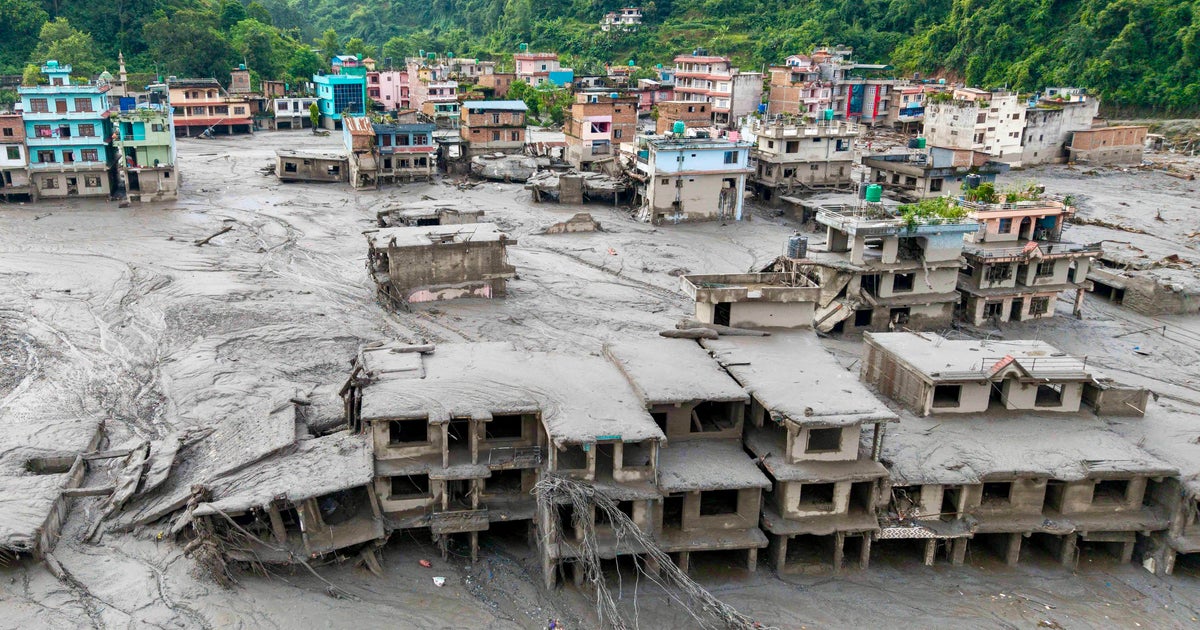
The deadly flash flood in Nepal on Wednesday was likely caused by a huge chunk of a glacier that broke off and temporarily dammed a river, according to preliminary investigations by scientists. That may have led to the backed-up water surging downstream with enormous force a few hours later, they suggested. Scientists are still piecing together information from satellite and ground-level data to figure out exactly what happened to cause the flood, which killed hundreds of people and left over a thousand more missing, including foreigners and pilgrims.
Geological Survey on Wednesday reported a magnitude 5.2 glacier collapse that sent debris flowing downstream with catastrophic impact on communities. It said its determination was based on data from nearby seismic stations, long-period seismic waves and satellite imagery. "A lower part of a glacier has really come off," said Jakob Steiner, a geoscientist at the University of Graz in Austria who is currently based in Bangladesh.
"If you look at the imagery it's like someone cut with a huge knife through the whole lower part and it fell off." Steiner said a mass of glacial ice dropping from a great height could have felt like a bomb exploding, resulting in the chaos that followed. Scientists said it is too early to draw a direct connection between global warming and Wednesday's catastrophe. However, they said that as Earth's temperature rises because of human activities such as burning oil, gas and coal, the chances of such disasters increase, especially in the Himalayan mountains, which are warming considerably faster than many other parts of the world.
"We have to be cautious and not draw a connection yet. However, rising temperatures are changing the Hindu Kush Himalaya region and melting glaciers," said Saswat Sanyal, a disaster risk reduction specialist at the International Centre for Integrated Mountain Development, a climate research group based in Nepal's capital of Kathmandu. The Hindu Kush Himalaya region spans roughly 2,175 miles, from Afghanistan to Myanmar, and is home to the highest mountains in the world, including Mount Everest.
It contains the largest volume of ice on Earth outside the two polar regions and is the source of water for 12 rivers that flow through 16 Asian nations. Those rivers provide fresh water to some 240 million people living in the region, and about 1.65 billion people further downstream, the climate research group said in a 2023 report. The group warned the melting of the glaciers would be a disaster for all of those people.
In this week's catastrophe, hundreds have lost their homes across the Himalayan region, and officials reported large-scale damage to critical infrastructure, including hydropower dams, roads, buildings and bridges in the region. Water levels in rivers across the flood-affected region rose by as much as 9 meters (29.5 feet) in 30 minutes as a result of the surge from the glacial detachment upstream, researchers at the climate research group said. "It was a huge rise, a huge surge of water that happened suddenly," said Sanyal.
Extract — continue reading at the source.