Stress resilience—the ability to maintain mental health after adversity—manifests in humans and rodents as efficient threat–safety discrimination and fear extinction. Although behavioral differences between resilient and susceptible individuals are well documented, the brain-wide structural signatures that distinguish resilience, susceptibility, and impaired threat learning remain poorly defined. Using a translational mouse model of chronic social defeat stress in male C57BL/6 J mice (n = 55), combined with preregistered multimodal magnetic resonance imaging with graph-theoretical analyses, we identify structural and network-level correlates of three behavioral phenotypes.
Resilient animals exhibited greater microstructural complexity in prefrontal regions, and showed signatures consistent with enhanced inhibitory gating within amygdalar circuits. In contrast, susceptible animals—defined behaviorally by fear generalization and resistance to extinction—exhibited dentate gyrus alterations across all measures, suggesting diminished microstructural adaptability. A third phenotype, impaired threat learning—mice that failed to avoid individuals from a threatening strain—was associated with altered CA1/CA2 microstructure and reduced structural connectivity in pons, pointing to disrupted hippocampal–brainstem interactions during memory consolidation.
These findings demonstrate that resilience, susceptibility, and impaired threat learning arise from dissociable patterns of brain organization, with resilience reflecting adaptive circuit-level organization and susceptibility and impaired threat learning exhibiting distinct forms of microstructural and network reorganization. Resilience is defined as the maintenance or rapid recovery of mental health when facing adversity [1]. In humans, several key behavioral features are associated with resilience, including the ability to discriminate between threat and safety cues, and the ability to extinguish fear when danger has passed.
In contrast, susceptibility is marked by fear generalization and resistance to extinction [2]. Rodent models, particularly chronic social defeat (CSD) in male mice, have been instrumental in advancing our understanding of resilience [3, 4]. Some mice develop social avoidance after repeated defeats, and we showed that this avoidance reflects correct conditioned learning where the aggressors’ strain is the threat-associated cue [5].
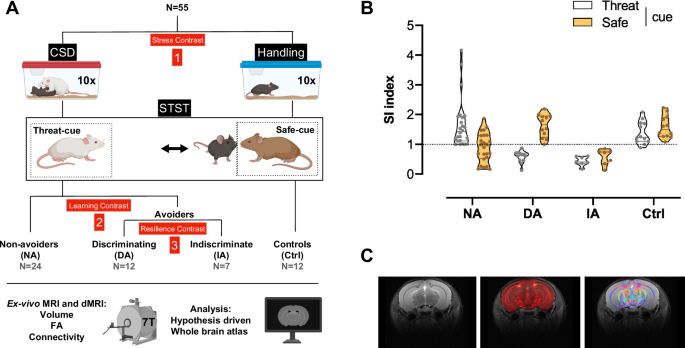
Using our validated social threat-safety test (STST), we recently identified three distinct subgroups after CSD: discriminating-avoiders (avoid only the aggressors’ strain, i.e., threat-safety discrimination), indiscriminate-avoiders (generalize fear to safe strains), and non-avoiders (fail to learn the threat association; [6, 7]; Fig. 1A). Only discriminating-avoiders extinguish avoidance (when facing aggressors’ strain from a safe distance), consistent with resilience in humans, whereas indiscriminate-avoiders resist extinction, reflecting susceptibility. Non-avoiders represent a third group with impaired aversive learning.
The ability to distinguish aversive from safe cues is critical for survival, and because this learning depends on the fear circuitry—one of the most conserved neural systems across species—our model provides a powerful framework for translational investigation. We previously showed distinct transcriptional signatures across the three subgroups in basolateral amygdala (BLA), medial prefrontal cortex (mPFC), and ventral hippocampus (vHC; 6). Other brain regions implicated in defeat-induced avoidance include the dorsal HC (dHC; [8]), and the ventrolateral subdivision of the ventromedial hypothalamus, part of the hypothalamic medial zone (HMZ; [9]).
Extract — continue reading at the source.