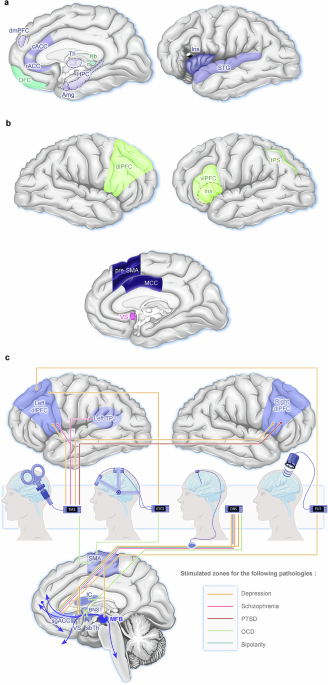
Neurostimulation of targeted brain regions has emerged as a novel therapeutic approach to induce remission in patients with various psychiatric disorders. This strategy encompasses several modalities, including transcranial magnetic stimulation (TMS), transcranial direct current stimulation (tDCS), deep brain stimulation (DBS), and transcranial focused ultrasound neurostimulation (tFUS), all of which aim to modulate dysfunctional neural circuits and restore activity toward physiological ranges. While the clinical efficacy of these techniques is increasingly documented, the mechanisms underlying their effects—beyond immediate changes in regional excitability—remain incompletely understood.
Further, neurostimulation represents not only a technical advance, but also a conceptual shift in psychiatry, moving from interventions aimed at modulating neurotransmission or cognition toward circuit-based models of mental illness. This review surveys the current literature to clarify the mechanisms of action of neurostimulation across multiple levels of biological integration, ranging from large-scale neural circuits to cellular and subcellular processes. Subsequently, it explores innovative targets and emerging modalities that expand the scope of circuit-based interventions beyond traditional approaches.
Finally, it engages in a critical epistemological reflection, addressing the conceptual challenges that accompany the translation of circuit-based models from neuroscience to clinical psychiatry. Psychiatric disorders, including schizophrenia, bipolar disorder (BD), obsessive-compulsive disorder (OCD), major depressive disorder (MDD), and post-traumatic stress disorder (PTSD), are disabling conditions that profoundly affect emotional, cognitive, and social functioning. The mainstay of treatment relies on chronic pharmacotherapy and sometimes psychotherapies.
However, these interventions remain markedly inadequate. Many patients experience only partial symptom relief with pharmacotherapies, while a substantial proportion exhibit treatment non-response or resistance. For example, over one-third of patients with MDD or schizophrenia do not experience significant improvement [1, 2].
Side effects further compromise adherence, long-term outcomes, and use in vulnerable populations (e.g. pregnant women). Psychotherapies, despite their low relapse rate, are also limited by cost, poor accessibility, and cultural barriers. These shortcomings highlight the pressing need for innovative, mechanism-based therapeutic approaches.
In this context, repeated neurostimulation has gained increasing attention as a promising alternative or adjunct to conventional therapies. Several neurostimulation modalities have demonstrated therapeutic potential across various psychiatric conditions. Repetitive transcranial magnetic stimulation (rTMS) has emerged as a non-invasive alternative, with substantial evidence supporting its efficacy in MDD, schizophrenia, OCD and PTSD, though protocols are still not fully standardized [3,4,5,6].
Extract — continue reading at the source.


