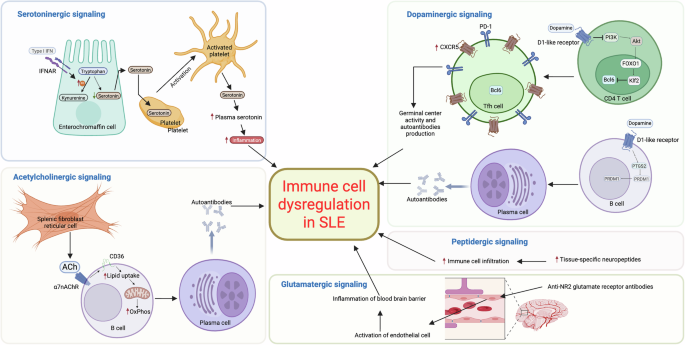
Autoimmune diseases arise from sustained breakdown of immune tolerance, chronic activation of innate and adaptive immune responses, and progressive tissue damage. Although cytokines, antigen receptor signaling, and genetic susceptibility have traditionally been considered the principal drivers, increasing evidence demonstrates that neurotransmitters have an underappreciated role in the pathogenesis of autoimmune diseases. The neuroimmune interactions link neural activity, psychological stress, and tissue innervation to autoimmune disease development, progression, and relapse.
In this review, we integrate current mechanistic studies demonstrating how neurotransmitters regulate innate and adaptive immune responses and discuss their role in autoimmune diseases. Autoimmune diseases develop when immune tolerance breaks down, leading to persistent inflammation, progressive tissue damage, and loss of organ function. Much of the earlier work in this field has focused on genetic susceptibility, antigen recognition, and cytokine-driven immune activation as the main drivers of disease1,2.
While these mechanisms are clearly important, they do not fully explain key features of autoimmunity. Disease activity is often marked by unpredictable flares, frequently triggered by psychological or physiological stress, and tissue damage tends to remain localized even in the presence of systemic immune activation3,4,5,6,7,8. Indeed, conditions such as type 1 diabetes, systemic lupus erythematosus, atopic dermatitis, and Graves’ disease show clear associations with stress, pointing to additional layers of regulation beyond classical immune pathways.
In this context, the nervous system has gained attention as an important contributor to immune regulation9. Lymphoid organs and peripheral tissues are richly innervated, allowing neural signals to directly influence immune responses. Neurotransmitters, in turn, act as key messengers linking these two systems.
Although traditionally viewed as mediators of neuronal communication, it is now well established that immune cells themselves can synthesize neurotransmitters and express their receptors, supporting local signaling networks, particularly in inflammatory settings9,10,11,12,13,14. Growing experimental and clinical evidence indicates that neurotransmitter signaling influences multiple processes central to autoimmune pathology5,11,15,16,17,18,19. For example, dopaminergic pathways shape T cell differentiation and B cell function; adrenergic signaling influences immune cell trafficking and sets the inflammatory tone, and cholinergic pathways regulate cytokine production as well as immune cell metabolism.
Serotonergic signaling intersects with tryptophan metabolism and pathways of immune activation and exhaustion, while neuropeptides released from sensory nerves can act early to initiate and amplify tissue-specific inflammation. In this review, we integrate current mechanistic and disease-focused evidence to propose that neurotransmitters function as context-dependent immune checkpoints, coordinating neural activity with immune signaling, metabolism, and tissue-specific cues. Neurotransmitters are chemically diverse molecules that include monoamines, amino acids, and neuropeptides.
Extract — continue reading at the source.


