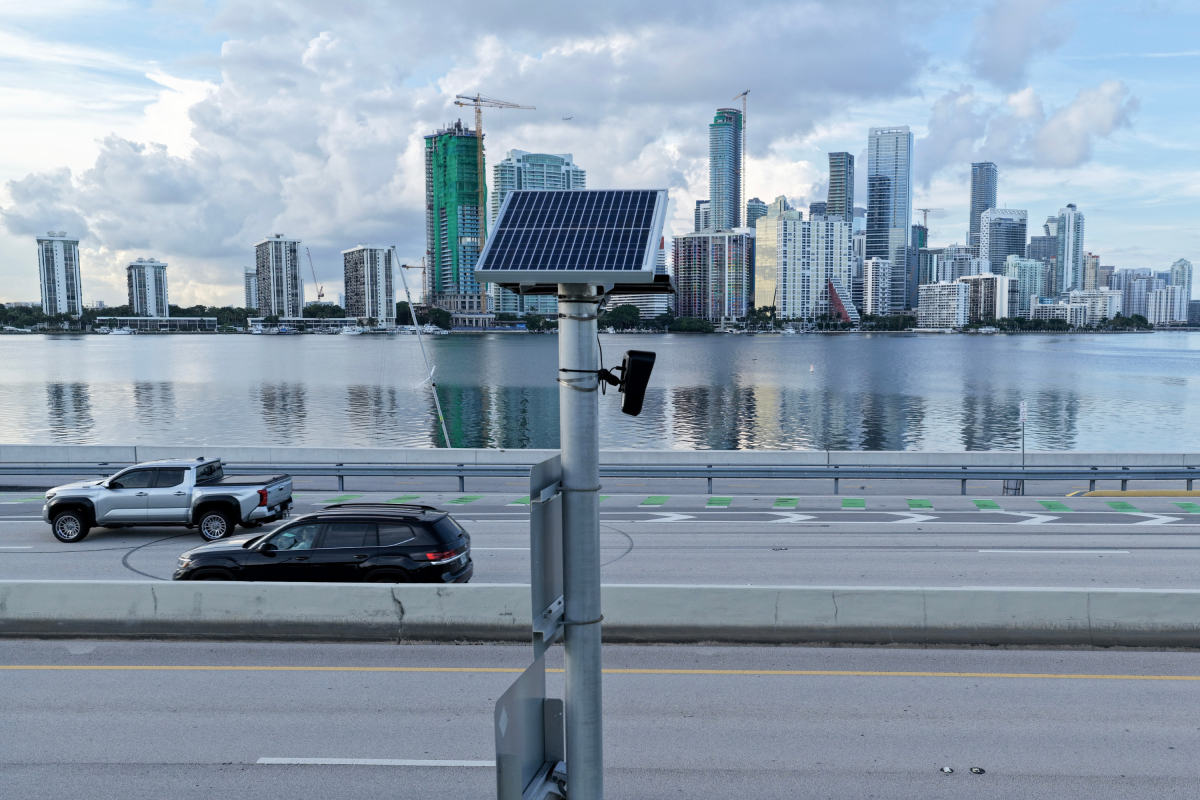
A Florida congressman has revealed new legislation that’s aimed at restricting the government's use of automated license plate reader (ALPR) technology, as fresh scrutiny falls on the true scale of Flock Safety's nationwide surveillance network and efforts to remove a map showing the locations of hundreds of thousands of devices. Representative Greg Steube, a Republican from Florida, introduced the Facilitating Liberty and Accountability for Flock Observations (FLAFO) Act on September 24. The bill would prevent federal agencies from purchasing, leasing, operating, accessing, or sharing data from networked ALPR systems without securing a warrant first.
It would also make sure that if state, local, or tribal police departments want to receive certain federal Justice Department grants, they would have to adopt privacy rules similar to the ones required by the FLAFO Act to get the funding. In a statement released by his office, Steube said the legislation was designed to curb what he described as the growing use of surveillance technology to monitor Americans' movements without individualized suspicion. "The Fourth Amendment is not optional.
Americans should not be tracked everywhere they drive without a warrant," Steube said. "Flock Safety’s surveillance network is expansive, and we have seen several instances across the country where this technology is too easily abused." Flock Safety CEO Garrett Langley told Newsweek in a video interview that Flock's "end goal isn’t a dystopian future of surveillance; it’s one where we all feel safe." He said that transparency and accountability are central to the company's approach. Newsweek has messaged Steube for comment and is awaiting a response.
According to Steube, the legislation was prompted by concerns that modern ALPR systems have evolved from helpful, localized crime-fighting tools into large-scale surveillance networks that can track vehicle movements across multiple law enforcement agencies. He argues that advances in AI and machine learning allow these systems to pull together detailed records of individuals' movements, associations and routines—without their consent and sometimes without any reason to do so. Steube also pointed to reported cases in Florida, Indiana, Illinois, and Wisconsin in which officers allegedly misused ALPR databases for unauthorized searches or to look up, follow, or keep tabs on people they personally know, rather than for a legitimate law enforcement reason, arguing that those incidents show why stronger safeguards, such as the FLAFO Act, are needed.
Flock Safety, headquartered in Atlanta, is the dominant player in the ALPR market, accounting for more than 80 percent of such systems in use nationwide, according to Steube's office. While the FLAFO Act would apply to all ALPR systems, the legislation appears to be largely aimed at Flock and its rapidly expanding camera network, hence the title "Facilitating Liberty and Accountability for Flock Observations." Newsweek has also contacted Flock Safety by email for comment about this and is awaiting a response. Steube's proposal comes days after cybersecurity researcher Joshua Michael published an interactive map that he says shows more than 300,000 Flock-linked surveillance devices across the United States, including more than 170,000 cameras and roughly 130,000 additional pieces of supporting equipment.
The map, known as the "Flock Surveillance Map," was created using location data that Michael said came from a snapshot of Flock's own records that was archived in December 2025. Unlike crowdsourced projects, such as DeFlock, that rely on public submissions noting where ALPRs are located, Michael's map is based on data that he says was extracted directly from the company’s actual system after he discovered a vulnerability that exposed information about where the devices were located. In a report published by The Intercept, Michael said the map illustrates what he views as a nationwide surveillance network capable of tracking vehicle movements on a massive scale.
Extract — continue reading at the source.