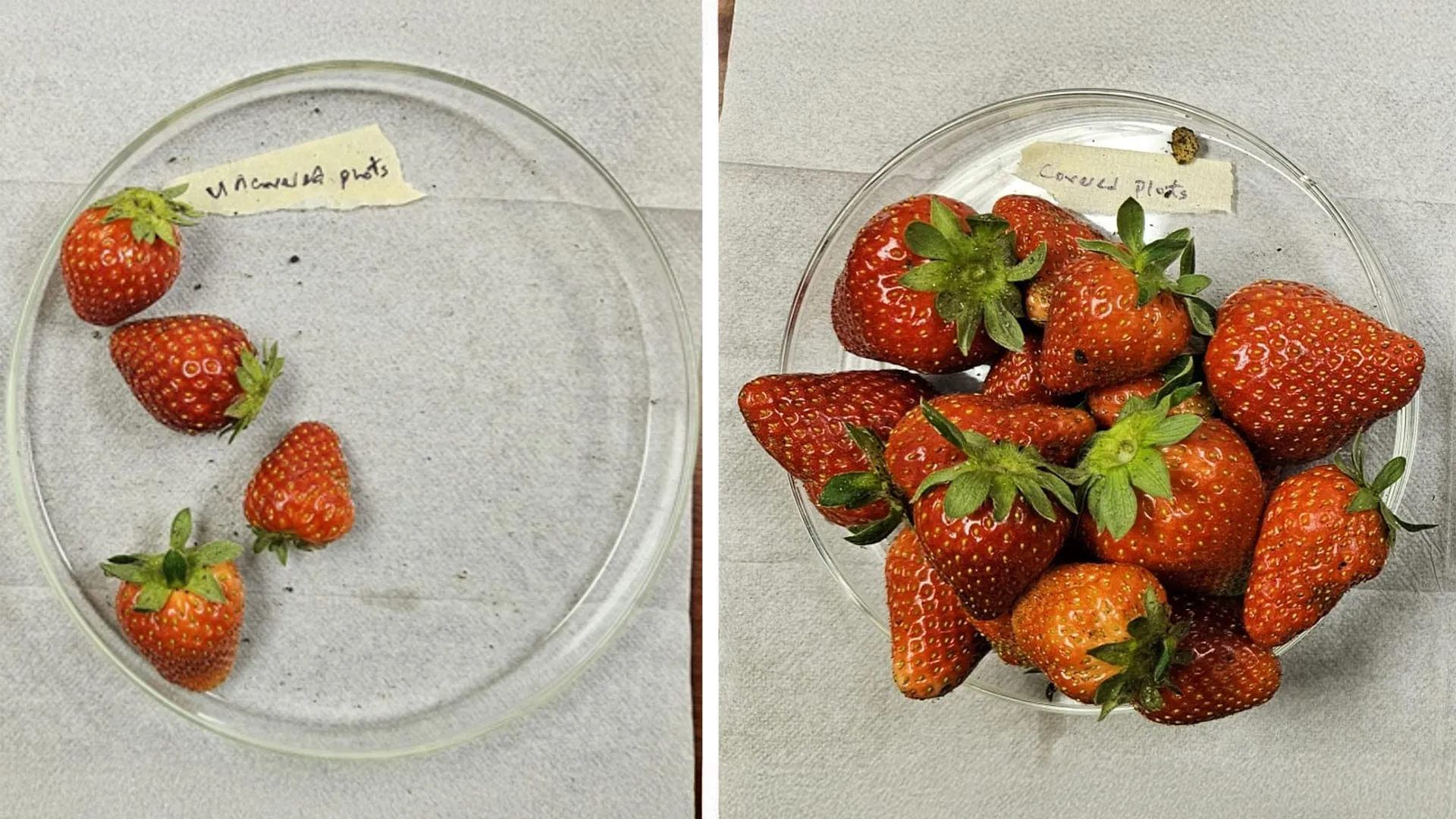
A newly developed textile covering helped strawberry plants produce more than three times as much fruit in tunnel field trials, while showing no harmful effects on plant health. Researchers say the technology may also offer a way to reduce water use and reliance on pesticides in strawberry production. The fabric, called Plant Armor, is designed to be placed directly over strawberry plants.
Its three dimensional structure creates a barrier that keeps insects from reaching the plants, while the layered material still allows sunlight, rain, and air to pass through. In tunnel field tests, strawberries protected by Plant Armor produced yields as much as 3.56 times higher than uncovered plants. The fabric did not reduce light availability or negatively affect relative humidity.
A Fabric That Protects Without Blocking Sunlight "To produce fruit, plants need sunlight," said Gabriel Olawuyi, a graduate research assistant at North Carolina State University and lead author of a paper on Plant Armor. "We expected that Plant Armor's seemingly opaque fabric would lead to an increase in vegetative biomass at the expense of fruiting -- because reduced sunlight would trigger a 'shade-avoidance' response, making the plant divert energy toward stem and leaf growth rather than fruit production. However, we found the fabric did not impede access to light at all, and fruit production increased significantly." Researchers also found that Plant Armor created a steady warming effect throughout the three growing seasons.
According to Olawuyi, that extra warmth helped covered plants reach the fruiting stage earlier than plants grown without the textile. "Plants require a certain amount of accumulated heat, calculated as 'growing degree-days,' to progress through developmental stages including fruiting. Our plant cover has proven to enhance these," Olawuyi said.
"The plants were in a condition whereby the warmth they need to go through each phenological stage to their production was given to them optimally, and they produced far more than the uncovered plants." Because Plant Armor physically prevents insects from feeding on the plants, Olawuyi said the technology could also reduce the amount of conventional pesticides needed in agricultural fields. From Military Textiles to Strawberry Fields The idea behind Plant Armor did not begin with farming. The technology emerged from research focused on making military uniforms more resistant to mosquito bites and improving comfort for soldiers wearing body armor.
That unexpected path from military clothing research to agriculture demonstrates the value of collaboration across scientific fields, said co-author R. Michael Roe, William Neal Reynolds Distinguished Professor at NC State. "The path to Plant Armor started with trying to make a cloth to go on a soldier's chest to make body armor more comfortable," said Roe.
Extract — continue reading at the source.


