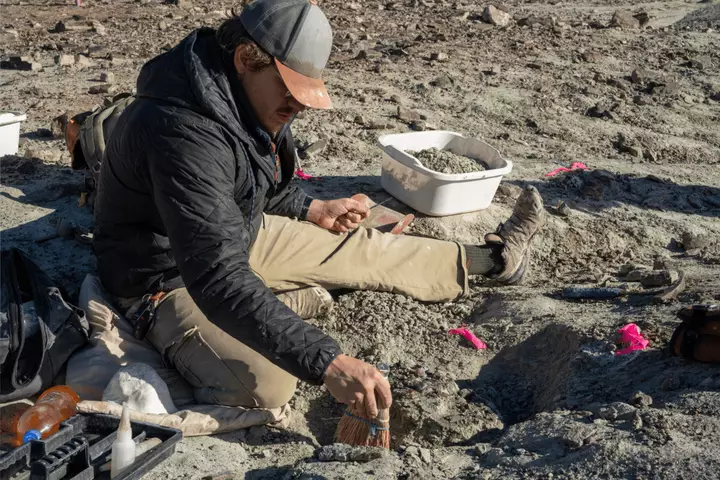
Paleontologists have begun excavating what could be one of North America's oldest known concentrations of fossilized dinosaur bones dating from the Cretaceous Period, with the site near Moab, Utah, already showing evidence of what researchers believe could be a previously unknown species of armored dinosaur. The Utah Geological Survey (UGS) said the new excavation site, near Arches National Park, was officially opened in mid-October and "may hold the key to understanding a major evolutionary turning point." Researchers estimate that the fossil-bearing site is between 138 million and 141 million years old. It’s located in the Moab area of eastern Utah, close to the state's national park country, and UGS believes it’s geologically very similar to the established Doelling's Bowl fossil site, which lies six miles to the east near the base of the Cedar Mountain Formation.
Eastern Utah is particularly rich in fossils because erosion has exposed layers of Mesozoic rock where the remains of a variety of plants and animals, including insects, marine reptiles and dinosaurs, have been preserved. Utah as a whole has one of the world's most complete fossil records, spanning almost 2 billion years. Perhaps the most significant discovery at the newly opened excavation site is the possible remains of a previously unknown armored dinosaur—a type of plant-eating dinosaur that has bony plates, spikes or other protective structures covering its body, like a Stegosaurus.
UGS said the species is currently being described and named by Utah State Paleontologist Jim Kirkland, who intends to name it in honor of his longtime colleague, Assistant State Paleontologist Don DeBlieux. A formal scientific description has not yet been announced, meaning the remains should (for now) be treated as a possible new species, rather than a formally established one. Newsweek has contacted Kirkland for comment.
The excavation marks a significant moment for the two paleontologists personally. Kirkland and DeBlieux have worked together for 25 years, and UGS said this is likely to be their final field season together, with DeBlieux due to retire at the end of 2026. Their work forms part of a much longer record of discoveries from the Early Cretaceous rocks around eastern Utah.
The UGS has previously described the Cedar Mountain Formation as an increasingly important source for reconstructing the region's Early Cretaceous geology, biology, geography and climate. At nearby Doelling's Bowl, for example, earlier UGS excavations uncovered a long-necked (sauropod) dinosaur skeleton that apparently became trapped in mud, as well as a deeper concentration of bones from iguanodontid dinosaurs, which are large, plant-eating dinosaurs with beak-like mouths for eating vegetation. Researchers also recovered a large, 4-inch tooth, which UGS said was almost certainly from a new species of large carnivorous dinosaur.
Newsweek’s reporters and editors used Martyn, our AI assistant, to produce this story. Learn more about Martyn here. Contact Newsweek editors on this story: Tobias Meyjes and Emma Lee-Sang
Extract — continue reading at the source.