This article has been reviewed according to Science X's editorial process and policies. Editors have highlighted the following attributes while ensuring the content's credibility: Researchers have fashioned a layered topological material into a scanning tunneling microscope (STM) tip that senses spin-related electronic states at atomic resolution. The research team, led by Chen Xianhui and Wang Zhenyu from the University of Science and Technology of China (USTC) of the Chinese Academy of Sciences (CAS), together with Xiang Bin from USTC, Liu Junwei from the Hong Kong University of Science and Technology and other collaborators, used this probe to obtain converging evidence for two-dimensional d-wave altermagnetic order on the surface of KV₂Se₂O.
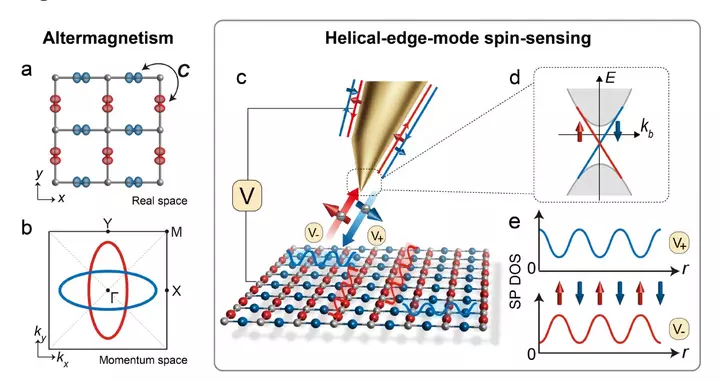
The study was published online in Nature on Oct. 13. According to the researchers, the approach builds on the quantum spin Hall effect. Along an edge of a quantum spin Hall insulator, electrons traveling in opposite directions have opposite spin expectation values.
Such one-dimensional "helical" edge channels have long been studied for their unusual electronic properties. In earlier work, the USTC team observed robust, weakly coupled helical edge states at steps in the related material α-Bi₄I₄. Building on this finding, the researchers explored whether these topological edge channels could be used to probe other materials.
The researchers used focused-ion-beam nanofabrication to shape α-Bi₄Br₄ single crystals into STM tips. The fabricated tips can resolve individual atoms while retaining spectral features consistent with helical edge states. When an edge channel dominates electron tunneling, reversing the sample-bias polarity changes the direction in which electrons enter or leave the tip and therefore can change its spin sensitivity.
To test this principle, the researchers examined two established magnets. In Fe₁₊ₓTe, the magnetic-stripe contrast reversed with voltage polarity. In FeGe, the contrast between adjacent unit-cell layers changed markedly when an external magnetic field induced a spin-flop transition in the sample.
The research team then applied the probe to KV₂Se₂O, a candidate altermagnet. Altermagnets have no net magnetization, yet magnetic exchange can split electronic bands in a pattern that alternates across momentum space in accordance with their unique crystalline symmetries. Identifying this order requires linking local atomic structure to spin-dependent electronic behavior.
Extract — continue reading at the source.


