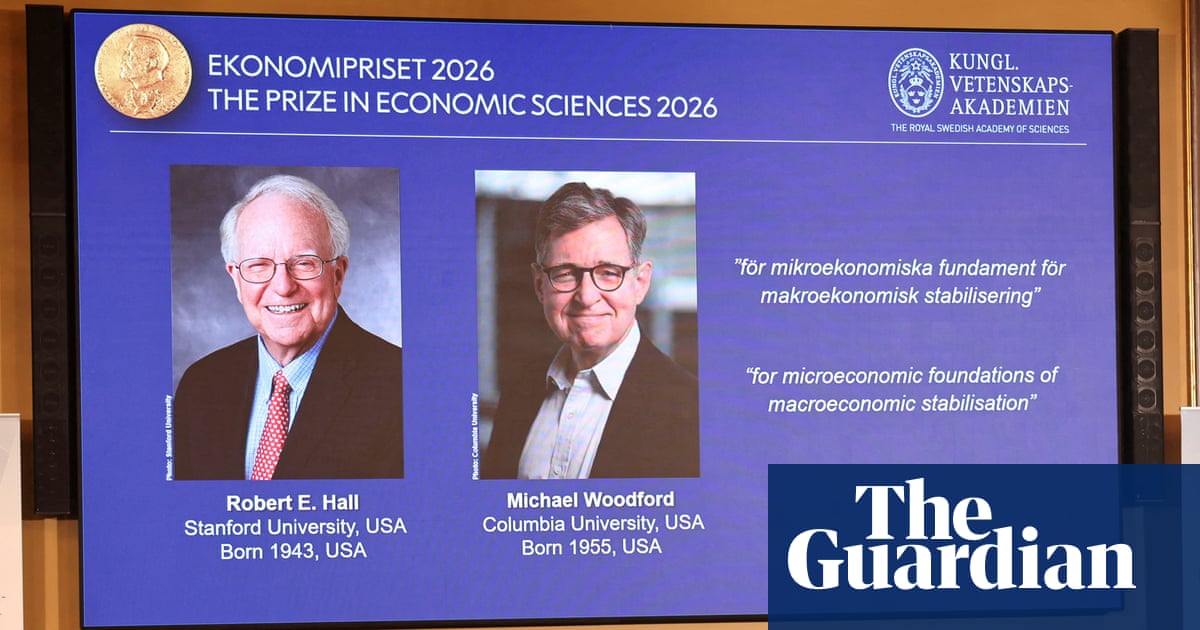
Two US economists have won the 2026 Nobel economics prize for their work developing models that help central bankers and finance ministers to stabilise their countries, avoiding long recessions and runaway inflation. Robert Hall of Stanford University, California, and Michael Woodford of Columbia University, New York, were recognised for developing the “microeconomic foundations of macroeconomic stabilisation”, giving policymakers better tools to smooth out the peaks and troughs of their economies. The Royal Swedish Academy of Sciences said it was recognising the pair for generating “a paradigm shift in stabilisation policy”, awarding them the prize worth a combined $1.2m (£900,000).
These models improved on John Maynard Keynes’s stabilisation models, which struggled to handle the impact of the oil shock in the 1970s, when countries suffered high inflation, weak growth and high unemployment at the same time. Hall and Woodford demonstrated how traditional models could be reconstructed, based on how individual households and businesses collectively affect an economy through their actions. Hall’s work was based on forward-looking consumer behaviour rather than the more mechanical rules of thumb used by Keynes, which linked key variables such as inflation, unemployment and gross domestic product (GDP).
Woodford built on this work to create the New Keynesian model, a full macroeconomic stabilisation framework that is the main tool for policymakers now. This model was used after the 2008 financial crisis by policymakers as they steered the global economy away from the risk of a second great depression. With them, we are better equipped to deal with shocks in the economy, such as energy crises or sudden changes in how much households consume,” John Hassler, the chair of the committee for the economics prize, said.
Hall and Woodford’s work also led to the development of forward guidance, where central bankers communicate where they expect interest rates to be in the future. That became an important tool after the 2008 financial crisis, and the Covid pandemic, when interest rates were cut to record lows. Forward guidance has had its critics, though – the current chair of the US Federal Reserve, Kevin Warsh, has argued it should only have a “limited and circumscribed” role in normal times, to avoid “creating ambiguity in the name of clarity”.
And in 2014, the then Bank of England governor, Mark Carney, was labelled an “unreliable boyfriend” for dropping hints over interest rate rises that never came to pass. Woodford said he was “elated”. It’s a surprise but I’m feeling very good about it,” he told reporters in Stockholm by phone after receiving the news.
The Columbia University president, Jennifer L Mnookin, said: “I offer my deepest congratulations to Michael Woodford on this tremendous honour. The fresh water group, who tend to be based at inland universities located near the Great Lakes, such as the University of Chicago, believe in free markets, neoclassical price theory, rational expectations and monetarism. Salt water economists, though, cluster at coastal universities, such as Harvard, MIT, UC Berkeley, Yale, Princeton, UCLA and Columbia.
Extract — continue reading at the source.