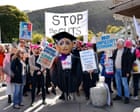
When adolescents protest that the government is failing to uphold their right to an education, and the government’s response is to send in riot police, the government has lost the plot. People outside France may have spent the past week watching the student protests in Paris and other cities, and thought, “Well, France has a long tradition of insurrection” or, “That’s just the French being French.” But the situation that has provoked the high-school walkouts and teenage anger is most likely not one they would immediately associate with the France of their imaginations. In place of its lost plot, the French government has a collection of anecdotes and statistics that it should be ashamed of: 27th place in the most recent OECD education rankings, schools with ceilings collapsing and rats in classrooms and, in a school in Bagnolet, no drinkable water; an increase in the average number of students per class from 27 in 2010 to over 30 today; half of primary and high schools missing teachers at the start of the school year – many of them with no substitutes or replacements.
Julie, a 34-year-old teacher who joined the demonstrations, told me that staff shortages were the fault of “low salaries and poor treatment.” She has to commute for an hour and 45 minutes each way between Paris and the school on the city’s outskirts where she accepted a post last year after switching careers. All for €2100 (£1,780) a month, plus some overtime pay. Teachers’ salaries in France are only 56% of what they are in Germany – even as over €200bn in public subsidies finds its way annually to businesses.
So it could easily have been a teacher-led revolt – instead, the high-schoolers themselves cracked first. They paid a high price for refusing to accept a failing education system: a 16-year-old has lost the use of an eye, a 15-year-old has lost a hand, a 14-year-old has a broken jaw – all from police munitions. Hundreds more have been injured in some way.
In total, 4,400 people, the vast majority minors, have been arrested in a little over a week, almost half the number of arrests made during the months of gilets jaunes chaos. It might be incoherent that protesting students shoot fireworks at high school buildings, while at the same time denouncing the poor facilities they have to study in. But the far greater incoherence belongs to a government that has disinvested in its youth, and has chosen to answer bin fires with police charges.
Despite “unlivable” temperatures in the school buildings, extreme heat and extreme cold, walls covered in mould, electricity cuts and often not enough tables or chairs for everyone, Fatoumata would rather have been in class than out braving the riot police. But she wants to teach history some day and felt compelled, in a moment in history, comparable to May 1968, to take part. And so this is for the next generation of students and teachers.” I can’t imagine how hard it must be to be a teenager in general today.
In 2021 The Lancet found that 75% of French 16-25-year-olds exhibited signs of eco-anxiety, telling researchers they were “frightened” about the future. In France and beyond, students and young workers actively dislike AI and feel pessimistic about the future it portends. As for Fatoumata, she worries about the rise of far-right political movements, both in France and elsewhere.
Extract — continue reading at the source.