Nociceptin orphanin F/Q has been implicated in stress-related depressive phenotypes. Specifically, exposure to chronic stressors upregulates nociceptin receptors (NOPR), whereas NOPR antagonism has antidepressant/anti-anhedonic effects. However, the mechanisms underlying reward-related effects remain unclear.
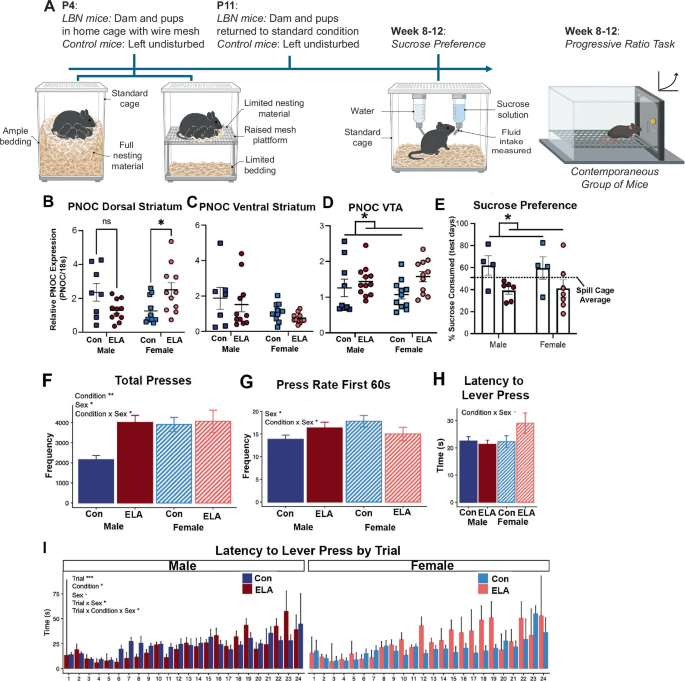
Here, we investigated the role of NOPR in a broad spectrum of reward-related phenotypes (reward consumption, reward learning, motivated behavior) alongside potentially prohedonic effects of NOPR antagonism across species. Study 1 evaluated whether exposure to early-life adversity upregulated ventral tegmental area (VTA) and striatal prepronociceptin (Pnoc) gene expression in adult mice. Study 2 assessed whether NOPR antagonism boosted reward learning in rats using the touchscreen-based Probabilistic Reward Task.
Finally, Study 3 tested whether NOPR antagonism modulated decision about motivated behavior using the Effort Expenditure for Reward Task among depressed humans. In Study 1, early-life adversity induced reduced sucrose preference and produced enduring and sex-dependent alterations in effort-related reward behavior, and increased Pnoc expression in the VTA; in females (but not males), early-life adversity increased Pnoc expression in the dorsal striatum. In Study 2, acute administration of 30 mg/kg (but not lower doses) of a NOPR antagonist (BTRX-246040) enhanced reward learning in rats.
Finally, in Study 3, relative to placebo, 8-week treatment with BTRX-246040 modulated choice consistency during a motivated task in depressed humans. Collectively, our findings indicate that chronic stress alters Pnoc and mRNA levels of Pnoc-expressing cells in a sex-selective and region-specific manner impacting reward structures, and that NOPR antagonism shows promising efficacy in increasing reward-related behaviors in rodents and humans. Future studies using similar manipulations and outcome measures across species are warranted.
This is a preview of subscription content, access via your institution Receive 12 print issues and online access Prices may be subject to local taxes which are calculated during checkout Data for Studies 1–3 are available on reasonable request. Software used in the present studies will be made available on reasonable request. Gavioli EC, Holanda VAD, Ruzza C NOP ligands for the treatment of anxiety and mood disorders.
Handb Exp Pharmacol. 2018. 233-57. https://doi.org/10.1007/164_2018_188. Ubaldi M, Cannella N, Borruto AM, Petrella M, Micioni Di Bonaventura MV, et al. Role of Nociceptin/Orphanin FQ-NOP receptor system in the regulation of stress-related disorders.
Extract — continue reading at the source.


