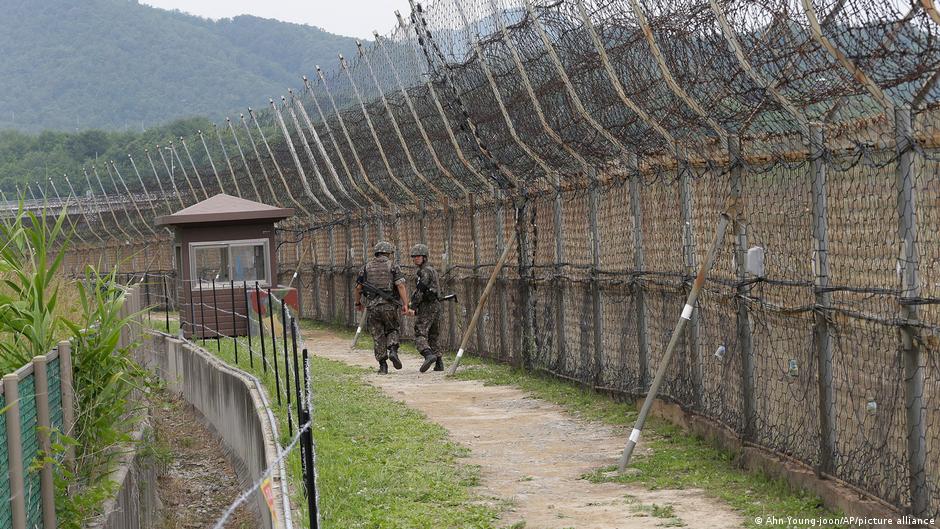
Pyongyang and Seoul are trading increasingly hostile accusations across the Demilitarized Zone (DMZ) that divides the peninsula, 10 days after three South Korean soldiers were injured by a land mine on the South's side of the border. The latest tensions may reflect a broader North Korean effort to test South Korea's resolve while extending its control to the outer limits of its territory, including an area that has effectively been a no-man's land for more than 70 years, according to a professor of foreign policy at South Korea's Kyung Hee University's department of Chinese studies "The North revised its constitution in March this year and officially stated that they intend to define the absolute geographical limits of the nation, and that includes within the DMZ," said Choo. "They want to maximize their territory and it is my sense that they would like to push the Military Demarcation Line [MDL] — the half-way point in the DMZ — further south," he told DW.
"I see the placing of landmines on the South's side of the line as a purely political act by the North, an attempt to threaten and intimidate the South." The three men were part of an 18-strong patrol clearing a new route through the DMZ as part of an investigation into the activities of North Korean troops in the western sector of the zone. The 4-kilometer-wide strip of land has divided the peninsula since the Korean War ended in an armistice in 1953. Shortly before 11 a.m. on September 21, the patrol was around 10 meters south of the MDL when a staff sergeant detonated a mine.
A second mine went off as the unit commander approached to provide assistance. Both men were successfully evacuated and have undergone surgery, with a third soldier treated for minor wounds. The South Korean military has conducted an investigation with the United Nations Command, which administers the armistice on the border, and concluded in a report released this week that the mine was of North Korean origin.
The Joint Chiefs of Staff on Wednesday accused the North of sowing mines to the south of the MDL, a breach of the armistice agreement, and demanded an apology from Pyongyang and a commitment to halt the construction of further fortifications along the border. "This constitutes a blatant violation of the Armistice Agreement and undermines the spirit of existing inter-Korean agreements and must be halted immediately," Kang Hyun-woo, chief director of operations, said in a press briefing. "North Korea must immediately cease activities that heighten tensions on the Korean Peninsula, such as its so-called 'border fortification.' We strongly demand an apology and responsible measures from the North," Kang added.
In a statement, the UN Command said it had "determined that an Armistice Agreement violation occurred. UNC is addressing the violation through established Armistice mechanisms." To view this video please enable JavaScript, and consider upgrading to a web browser that supports HTML5 video Many in the South are demanding more resolute action on the grounds that failure to respond will be taken as a sign of weakness in Seoul. Na Kyung-won, a politician from the conservative opposition People Power Party (PPP), has demanded that the South Korean military carry out exercises simulating a "decapitation attack" against North Korean leader Kim Jong Un.
She has also called for the restart of propaganda broadcasts from loudspeakers on the border and for dissident groups to be allowed to launch balloons carrying propaganda into the North. Yu Yong-weon, also of the PPP, told reporters on Wednesday that North Korean troops had crossed the MDL around 20 times in August and on 30 occasions in September. On each occasion, South Korean troops fired warning shots when the incursions were detected.
Extract — continue reading at the source.