While U.S. competition with China dominates discussions around artificial intelligence, rare earth metals, trade and defense, another race is quietly underway—and the winner could shape the future of energy. The prize, nuclear fusion, could be a near-limitless long-term energy source. Its fuel is mainly isotopes of hydrogen—the most common element in the universe.
"We need to understand that what's actually at stake here isn't just an energy technology—it's a potential reordering of global power," David Lin, senior adviser for tech leadership and fusion energy at the Special Competitive Studies Project (SCSP) think tank, told Newsweek. Unlike fossil fuels, fusion does not rely on combustion. And unlike nuclear fission, there's no risk of a catastrophic meltdown.
Fusion is also not at the mercy of weather conditions as solar, wind, and wave power so often are. No country has generated electricity from fusion on the scale needed for commercial power. But the technology already has the interest of a growing number of future-focused companies, including AI firms that have signed deals for power years before it's ready.
Trump Media & Technology Group, the parent of President Donald Trump's media firm Truth Social, is one of these players. It's merging with California-based fusion developer TAE Technologies this year in a deal worth over $6 billion. Fusion occurs in most stars when light atomic nuclei collide.
Reproducing it on Earth requires temperatures exceeding 180 million degrees Fahrenheit. While several means of achieving fusion have been explored, most experiments are held in tokamaks, a Russian acronym that describes a ring-shaped construction where magnetic coils contain superheated plasma and keep it from damaging the reactor wall. American scientists have more than half a century of experience, dating back to early programs that emerged from mid-20th century nuclear weapons research.
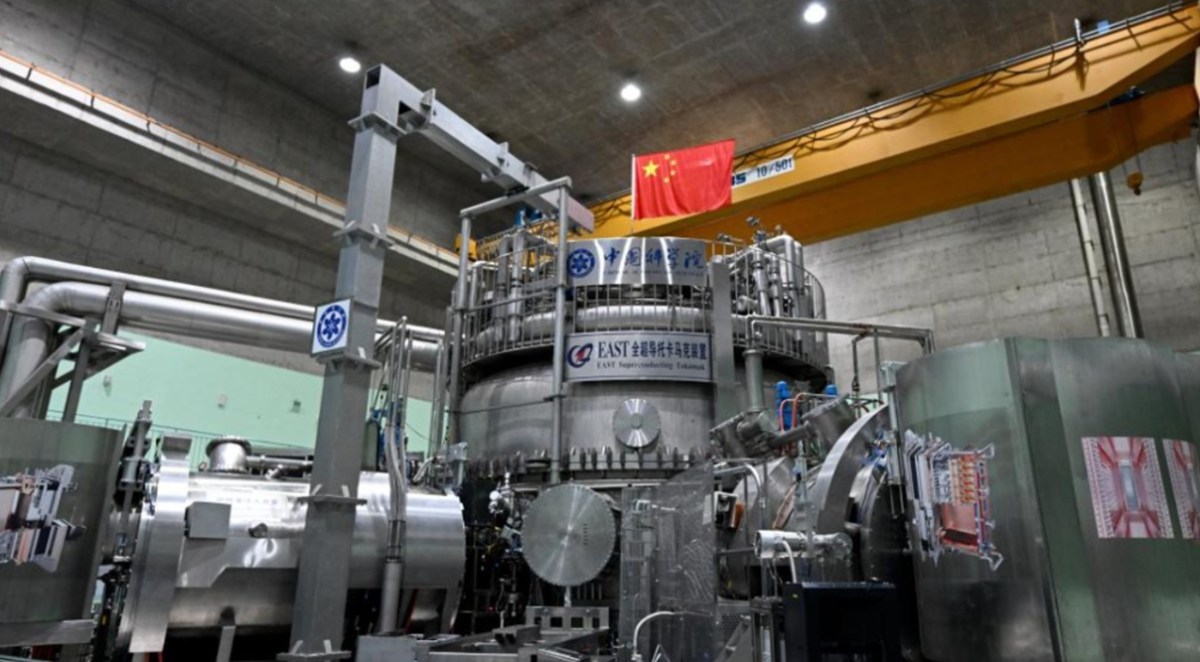
In 2022, scientists at the Lawrence Livermore National Laboratory's National Ignition Facility in California achieved a key milestone with a fusion reaction that produced more energy than was required to ignite it. But while the country retains an edge in research, superconductors, software and lasers, this lead is narrowing as China closes the gap through heavy investment and its rapid build out of new facilities. In June, scientists at the Institute of Plasma Physics in Hefei, in the eastern province of Anhui, said the Experimental Advanced Superconducting Tokamak (EAST), dubbed China's "artificial sun," announced they had successfully tested two domestically developed parts critical to future commercial reactors: a toroidal-field magnet and a high-temperature superconducting central solenoid coil.
Extract — continue reading at the source.