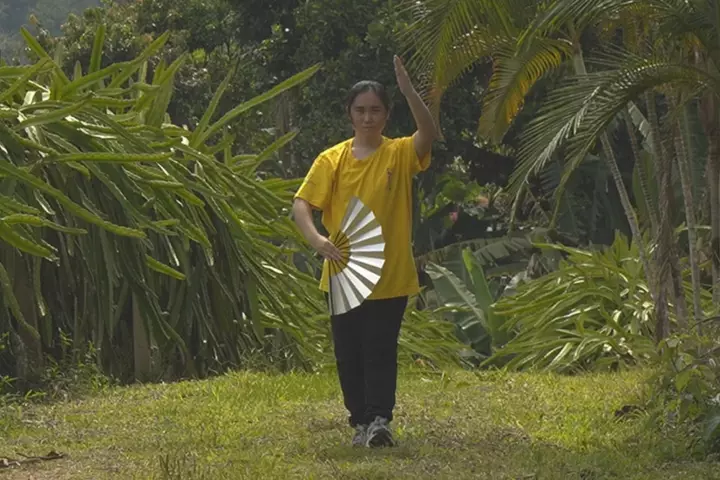
Exploring the relationship between people and place, new documentary “Okinawa Saudade,” playing at the 39th Tokyo International Film Festival as part of its Nippon Cinema Now selection, was born from director Matsubayashi Yoju’s time with a Brazilian community of Okinawan immigrants some 10 years ago. The film zooms in on the latest generation of Okinawan immigrant families: Yumi, a young dancer of Ryukyu Buyo, Okinawa’s classical dance, and Everton, who teaches Eisa, the island’s drum-led festival dance, in Brazil. The two travel to Okinawa on an exchange trip to learn about the island’s history and culture.
At the time I was trying to work on this other project about Fukushima, but it wasn’t going well so I just decided to, you know, lay back and just have beers in the morning, etc.,” Matsubayashi says. So that’s actually the starting point of the project.” The Bunkyo, a cultural facility in São Paulo’s Liberdade district, a neighborhood with a particularly high concentration of Japanese immigrants, kept a vast and detailed library of immigrant documents in Portuguese and Japanese. It was an invaluable resource for Matsubayashi’s research, but the director also found inspiration in the sheer quantity of material, rather than just the data itself.
The Okinawan records, he adds, came to almost the same volume. I was really amazed at that vast amount of information that the Okinawans wanted to keep.” While making the 2020 film, Matsubayashi says, he was still an outsider, not being from Okinawa himself, but he became embedded in the community while filming interviews, and those interviews led to a deeper connection. By 2024, Matsubayashi had heard that the Brazilian government would give the victims of the forced relocation a form of official apology that July, and that Okinawan Brazilians might receive scholarships for an exchange program, with training in September.
Brazil’s Amnesty Commission formally apologized that July for the state’s post-World War II persecution of Japanese immigrants. Matsubayashi built the film around a search for one’s roots, and chose to tell it through Okinawan dance. He draws a distinction between the dance in its “traditional” forms in Okinawa and the “Creative” forms that emerged later.
But with Creative Eisa, you don’t need to have the sanshin.” “I think this is a film that’s done in a first person perspective: of Yumi, Everton, and myself. I am also in the film asking [myself], ‘Who am I, what kind of person am I?’ So it’s three people trying to ask that question in the film,” the director says. It’s a rather intimate point of view for following his subjects as they navigate these cultural nuances.
I think ‘Okinawa/Santos,’ that one was more about putting together different testimonials, and so that’s a big difference there,” Matsubayashi says. He suggests the subject let him lean further into a more subjective kind of filmmaking. Matsubayashi says that with “Okinawa/Santos,” he was able to work on TV programs for NHK, Japan’s public broadcaster.
Extract — continue reading at the source.