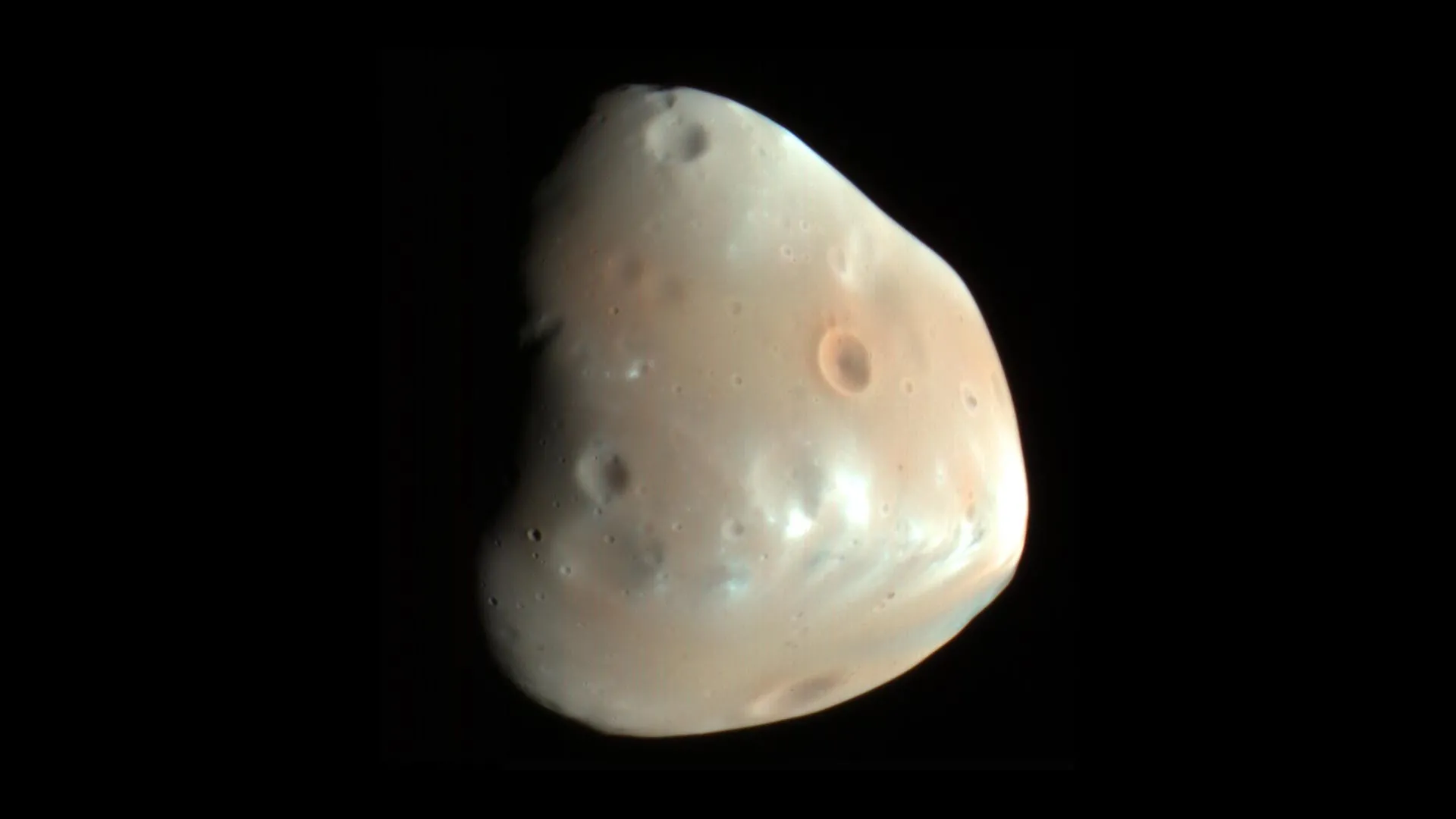
An international team led by the University of Bern has found evidence that a single asteroid collision may have dramatically reshaped Deimos, the smaller of Mars' two moons. By combining detailed computer simulations with recent images from ESA's Hera spacecraft, the researchers concluded that one impact could account for both the moon's large southern depression and its unusually smooth, dusty surface. The research is the first scientific study to incorporate observations collected during Hera's flyby of Deimos.
The findings could also help guide future missions, including the Japan Aerospace Exploration Agency (JAXA) Martian Moons eXploration (MMX) mission. Deimos is the smaller and more distant of Mars' two moons. It has a roughly oval shape and a prominent depression near its south pole.
Its surface also looks strikingly different from that of Phobos, Mars' other moon. While Phobos is heavily marked by craters, Deimos appears smoother because much of its surface is covered by loose dust and rocky debris known as regolith. Spacecraft have photographed the moon with increasing detail over several decades, but scientists have not been certain what created either the southern depression or the widespread layer of debris.
Sabina Raducan investigated whether the two features could share the same origin. The international collaboration included researchers from the Observatoire de la Côte d'Azur, the University of Arizona, and the University of Tokyo, among other institutions. Raducan worked in the Division of Space Research and Planetary Sciences (WP) at the Physics Institute at the University of Bern until October 2025.
She is now Science Program Manager at the International Space Science Institute and a Senior Fellow at the Vrije Universiteit Brussel. Using high-resolution simulations produced with the "Bern Smoothed Particle Hydrodynamics (SPH)" code, the team found that the distinctive depression near the south pole was most likely produced by a single asteroid impact that was powerful but not strong enough to destroy Deimos. According to the simulations, the same collision could also have generated the regolith that now blankets much of the moon.
The research, published in Nature Astronomy, is the first scientific publication to use observations gathered when ESA's Hera spacecraft flew past Deimos. Hera is currently traveling toward its main destination, the asteroid moon Dimorphos. To reconstruct what may have happened, the scientists used the Bern SPH code, which has been developed at the University of Bern over roughly two decades.
Extract — continue reading at the source.