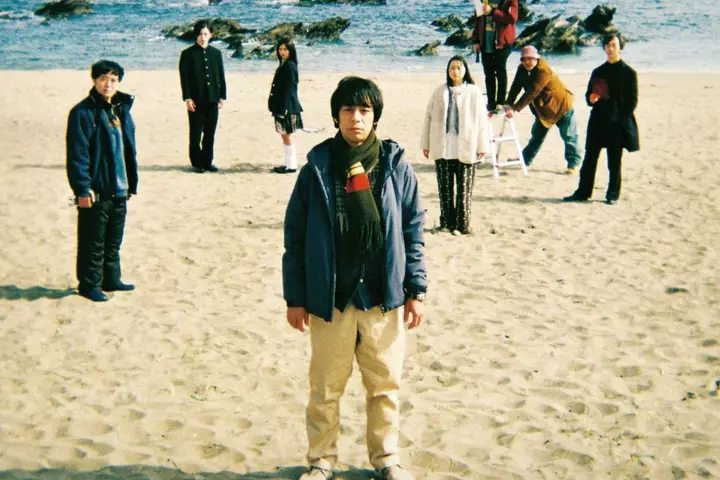
Director Ueda Shinichiro made a name for himself with filmmaking that has embraced self-reflexivity: the beloved cult zombie film “One Cut of the Dead” was continually transforming, from a single-take horror-comedy into a meditation on the act of filmmaking and then the chaos of actually being on set. His new feature “Earthlings in Love,” showing in the Nippon Cinema Now section of the 39th Tokyo International Film Festival, brings that interest in how filmmaking influences us into a curious new space: the vertically shot, social media-friendly microdrama. Setting out on a journey to record his memories, he decides to finish shooting a film he began making with friends as a teenager.
The film began as a series of 30 short episodes released on social media, each only a few minutes long. According to Ueda, an enthusiastic online response encouraged its adaptation to feature length and a theatrical release. Variety spoke to Ueda about bridging the gap between mediums, and about filmmaking about filmmaking.
Was the method of vertical filming decided before the script was written, or after? Vertical first, and then we thought of the screenplay. The work itself was not originally conceived as a feature film – I did plan it as an idea for vertical social media, but I think I have more of a nature that fits feature films, and that’s what I’ve been doing. [As for] where the storytelling and the concept come from, I visited my local town and met my old schoolmates there.
We were having drinks, and when we were talking about memories, I realized that there were some differences in how we interpreted the same events we had experienced, and some things that were completely forgotten. So my own experience is the basis for some part of the story. I wanted to create a story about the difference between memory and what has been recorded.
What appealed to you about filming this way, and what took readjustment in how you frame scenes with less horizontal space? I believe that the aspect ratio really fits human [proportions] very well. [While] it’s a good format for shooting one person, when it comes to group shots, there are some challenges and restrictions. The vertical frame often, deliberately, leaves out information that we then discover later from a different angle.
That is how I took some advantage of it – it leaves things to the viewer’s imagination. There’s also another thing, because the topic here is young-onset dementia. You may know that some symptoms of dementia do limit vision.
Extract — continue reading at the source.