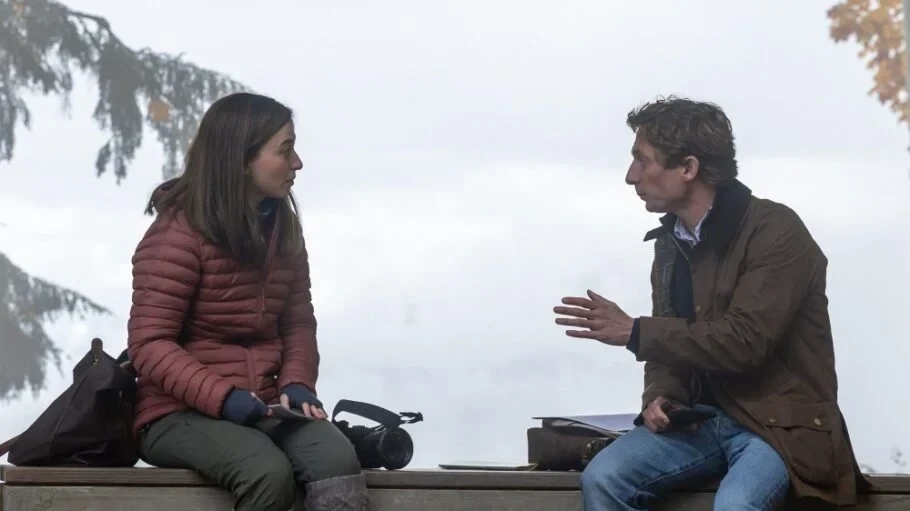
Both excellent as strangers whose relationship begins the day they’re both diagnosed with the disease, the stars give necessary ballast to John Madden’s soft-centered film. There’s nothing fun about Parkinson’s disease, and no film about it can engineer an uncompromised happy ending. But John Madden’s “Onwards and Sideways” finds more uplift than one might expect in a story of two people, both living with Parkinson’s, exploring the possibilities of living with it together.
It’s generally sunny and soft in outlook, though not blind to the disease’s debilitating effects on the body and mind — thanks to the firsthand insight of veteran TV comedy writer and Parkinson’s activist Paul Mayhew-Archer (“The Vicar of Dibley”), bringing his personal experience of the disease to his first feature screenplay. Even when the film strays into anodyne territory, it’s given genuine feeling and integrity by stars Laura Linney and Rhys Ifans, both superb as strangers in rural England who are initially blindsided, and gradually drawn together, by their shared diagnosis. A gala premiere at Toronto, “Onwards and Sideways” is likely to be a crowdpleaser beyond the festival circuit, particularly on home turf in the U.K., where the under-served gray-pound audience should turn out when it hits theaters on November 6.
This BBC-backed production does, however, have an air of high-end TV to it, both in the slightly programmatic nature of Mayhew-Archer’s writing and a blandly bright, utilitarian mise-en-scène. Madden, the Oscar-nominated director of “Shakespeare in Love,” has never been one for cinematic fireworks, but his latest benefits from his facility with actors and heart-forward storytelling. Ifans, too often cast as offbeat eccentrics or miscreants since his breakout role in “Notting Hill,” gets to play it straight here, and disarmingly so: As Tony Evans, a dedicated elementary school teacher for over 30 years, he exercises a shuffling gentleness that complements Linney’s more declarative American gusto.
Widowed and nearing 60, Tony enjoys a quiet but contented routine, suddenly injected with anxiety when, during the school day, one of his young pupils innocently notes that his right hand looks frozen. His sister Liz (Monica Dolan), a well-meaning but overbearing fussbudget, insists on accompanying him to the hospital for an appointment with plainspoken neurologist Professor Ridge (Rory Kinnear), who can tell at a glance that he has Parkinson’s; his briskly pragmatic approach (medicate, observe, check back in a year) is little comfort to Tony, who’s left reeling by the news. In the lobby, he gets talking to Yank expat piano teacher Emma (Linney), who’s just been dealt the exact same blow.
Her response, however, is more proactive than his. Where Tony persists in a state of semi-denial, keeping his diagnosis a secret at work, Emma dutifully reads all the literature and immediately seeks out support groups. She eventually finds her place in a Parkinson’s ballet class that might promise a degree of quirky comedy — you can’t blame Tony for initially being wildly put off — but it’s a therapeutic outlet that the film takes pleasingly seriously.
Though they are brought together under a mutual cloud of very bad news — more a meet-bleak than a meet-cute — there’s little doubt that Tony and Emma will soon figure heavily in each other’s lives, particularly when it’s revealed that they’re both single and a bit lonely. (In a peculiar bit of narrative wrongfooting, the script initially sets up the impression that Tony and Liz are a couple, a fakeout that doesn’t yield a big enough laugh to make it worthwhile.) Their bond deepens with the wry neuroses and gradually dropped defenses of many a midlife romantic comedy, though Parkinson’s complicates matters in unusual, empathetically explored ways. The film is frank about the difficulties they find in establishing a physical relationship, but companionship can take many forms. Linney, always at her best playing put-upon women trying to retrieve a stable life from a turbulent one, gets the biggest dramatic notes to play here — an otherwise sensible, straitlaced sort, Emma suffers from a gambling addiction that we learn is enabled by certain Parkinson’s medications — while grounding proceedings with her signature flustered warmth and humor.
Extract — continue reading at the source.