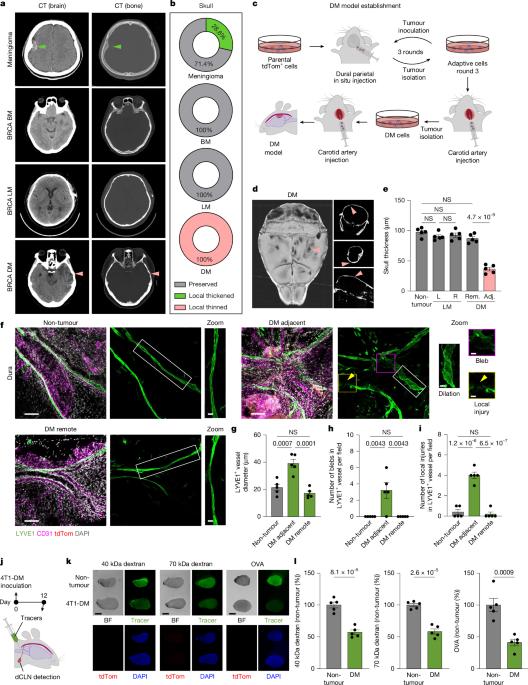
Dural metastasis (DM)—a devastating complication of advanced malignancies such as breast and lung cancers—is defined by tumour cell infiltration into the dura mater and presents unique clinical challenges distinct from brain metastasis1,2. Our study unveils a, to our knowledge, previously unrecognized role of meningeal lymphatic dysfunction in DM pathophysiology, providing a new conceptual framework for this unique form of metastatic disease. Distinctive cranial erosion patterns, identified through clinical imaging, set DM apart from other metastases.
Using a new mouse DM model, we discovered significant impairments in meningeal lymphatic drainage associated with tumour progression. Through single-cell RNA sequencing analysis, we characterized the tumour micro-environmental landscape of DM, highlighting the predominant immunosuppressive tactics driven by cancer-related osteoclasts (OCs). Notably, large OCs localize specifically at the skull–tumour interface, whereas smaller OCs permeate intratumoral regions.
We found that these OCs disrupted lymphatic paths significantly, and targeting them therapeutically led to restoration of meningeal lymphatic structure and function in DM, thereby augmenting anti-tumour immune responses. Mechanistically, we demonstrated that OC-derived angiopoietin-2 contributes to the dysregulation of meningeal lymphatic drainage in the DM model. Our findings suggest a new therapeutic approach to restore meningeal lymphatic function through selective OC targeting, offering promising avenues for enhancing anti-tumour immunity and improving clinical outcomes in patients with DM.
This is a preview of subscription content, access via your institution Access Nature and 54 other Nature Portfolio journals Get Nature+, our best-value online-access subscription Receive 52 print issues and online access Prices may be subject to local taxes which are calculated during checkout All raw and processed scRNA-seq data generated during this study were deposited with the Gene Expression Omnibus (GEO) database under accession number GSE284281. The RNA sequencing data of meningeal LECs were also deposited to the GEO database under the accession number GSE325223. The scRNA-seq data used for control OCs were obtained from the GEO database under accession number GSE147174 (https://www.ncbi.nlm.nih.gov/geo/query/acc.cgi?acc=GSE147174).
Source data are provided with this paper. All data analysis and processing were executed using published software or packages, the details of which were described previously and are referred to in Methods. No new code or mathematical algorithms were generated by this study.
Laigle-Donadey, F. et al. Neurooncol. 75, 57–61 (2005). Intracranial dural metastases.
Extract — continue reading at the source.


