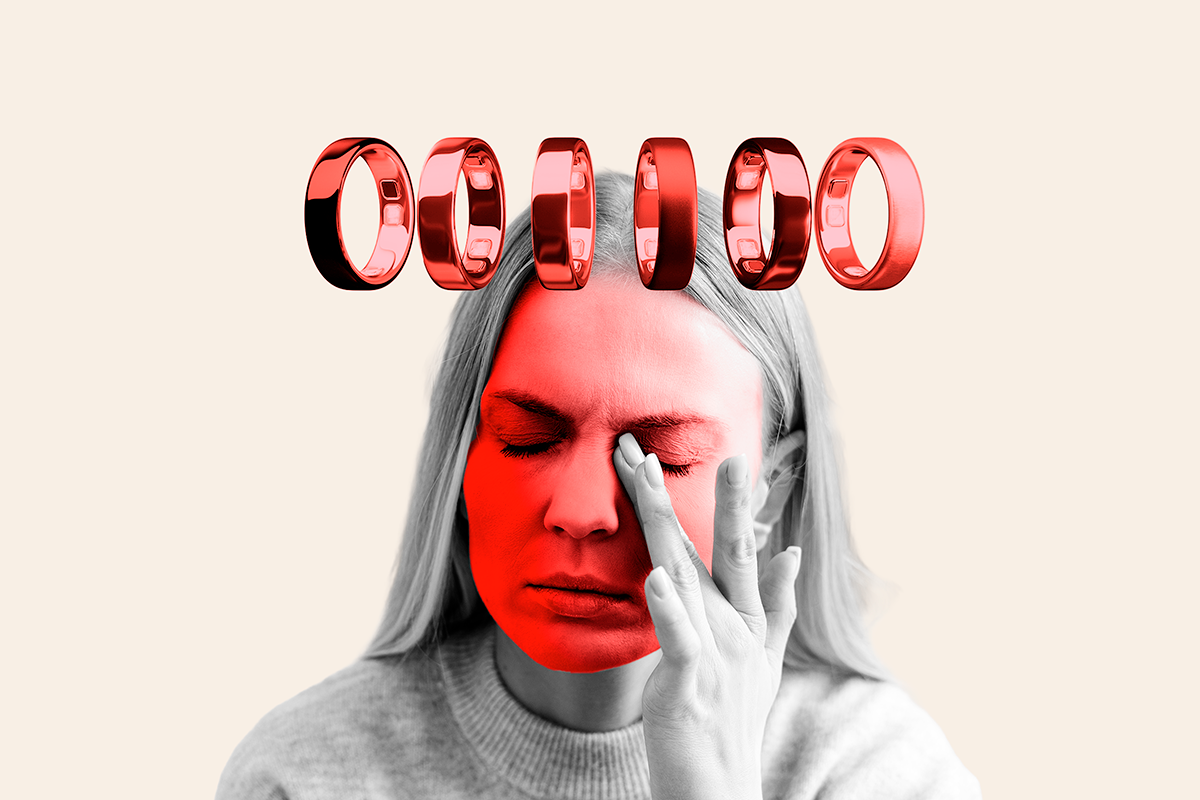
Plagued by health anxiety and a tendency toward hypochondria, I have often thought I would like to visit a doctor every morning. Before answering an email, drinking a second coffee or noticing a headache and diagnosing myself with something terminal, I would receive a complete examination and a clean bill of health. This is financially, medically and logistically impractical.
The next best thing, apparently, is the Oura Ring, which I have yet to buy—although I’m told American Express Platinum cardholders can get a $200 credit toward one, so perhaps I’m about to become an Oura person. Oura appears to promise exactly what I want from my imaginary daily doctor: an authority monitoring my every essence, watching my temperature, heart rate, breathing, stress, activity and sleep, perhaps alerting me that I am getting sick before it even occurs to me. Every morning, it reduces the mysterious condition of being alive to three reassuringly legible numbers: a Sleep Score, an Activity Score and, most seductively, a Readiness Score.
That last one answers a question Americans increasingly seem unable to answer for themselves: how am I today? Oura’s answer has become incredibly valuable. The Finnish-American company is reportedly preparing to raise as much as $3 billion in a U.S. initial public offering that could value it at more than $16 billion.
It has sold millions of rings and built a business around a striking modern proposition: you may think you know how you feel, but your body possesses information that only a device (this device) can properly interpret. The Oura Ring is therefore more than another wearable: it may be the perfect product for the exhaustion economy, an expanding marketplace built around the conviction that everyone is tired, nobody knows exactly why, and one more stream of data might finally explain it. Sounds like 2026 in a nutshell.
There is some factual basis to the theory that we’re all, well, exhausted. In 2024, 30.5 percent of American adults reported sleeping fewer than seven hours a night, according to the National Center for Health Statistics. Only 54.8 percent said they woke feeling well-rested most or every day.
Among adults ages 35 to 49—the demographic attempting to raise children, maintain careers, manage aging parents, pay mortgages and remember 16 separate school theme days, the most tired-prone of all—barely half regularly woke feeling rested. The exhaustion economy performs a useful cultural trick: it converts conditions that may be economic or emotional into defects that appear individually measurable and potentially optimizable. As Deborah Lupton, a SHARP professor at the University of New South Wales’ Centre for Social Research in Health, told Newsweek: “In the West, we live in a very individualistic society in which it is expected that we all take responsibility for our own health and reducing risk.” The result, she said, is that responsibility for keeping people well increasingly moves from the state to the individual, while those living in disadvantaged circumstances are blamed for poor health rather than asked what support they have been denied.
Extract — continue reading at the source.