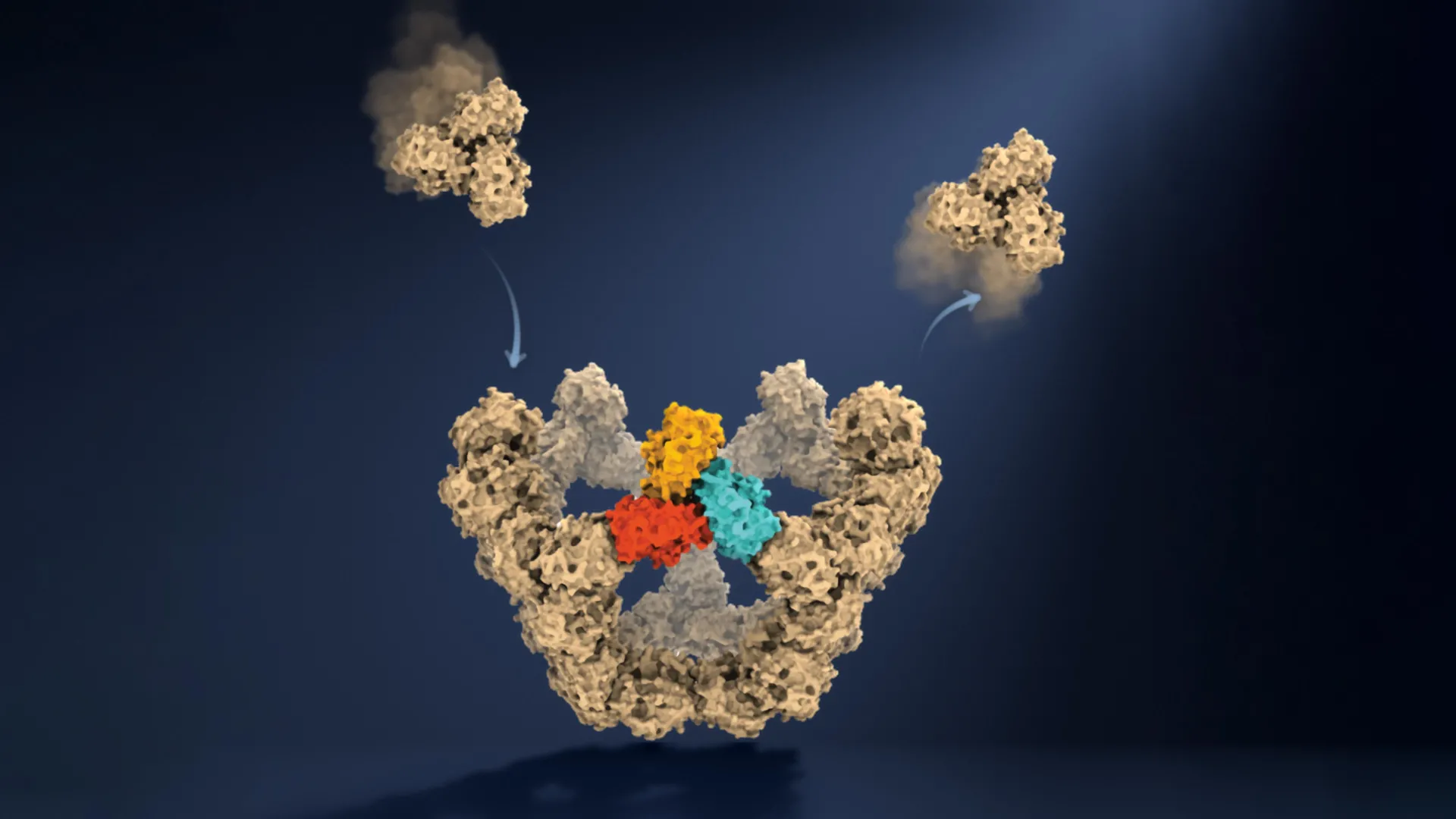
Researchers at the University of Oxford have observed virus-like particles assembling themselves one molecule at a time, uncovering the surprisingly simple rules that allow complex biological structures to form with remarkable reliability. The findings, published in Nature, offer a detailed look at a process that scientists have struggled to observe directly for decades. Understanding how viruses construct their protective protein shells, and how that construction might be interrupted, could lead to new antiviral drugs, improved vaccines, and other medical treatments.
The discovery helps explain how individual proteins consistently organize themselves into the correct structures despite having thousands of possible ways to connect. The researchers found that viral assembly resembles navigating a complicated maze, where only certain paths lead to lasting progress. At first, protein components form weak connections that can easily break apart if the arrangement is unsuccessful.
This flexibility allows the molecules to keep trying different combinations until they form particular closed structures. Once multiple connections hold these structures together, they become far more stable. These stable arrangements serve as molecular checkpoints, narrowing the enormous number of possible assembly routes into a much smaller set of successful pathways.
One especially important milestone occurs when five larger protein building blocks connect to form a closed pentagonal ring. This is the first highly stable structure in the assembly process. Once it forms, each subsequent stable stage requires fewer additional building blocks, allowing the particle to grow more quickly.
Roi Asor (Department of Chemistry and Kavli Institute for Nanoscience Discovery, University of Oxford) explained: "A virus has to solve an extraordinary construction problem. Its components somehow have to find the right arrangement among a huge number of possibilities, without a blueprint or machinery directing the process. We can now watch what happens molecule by molecule and see the physical rules that make it possible." Watching Virus Particles Assemble Molecule by Molecule Viruses store and protect their genetic material within organized protein shells known as capsids.
Depending on the virus, these shells may consist of tens or even thousands of individual protein components. Remarkably, in many cases, the proteins can arrange themselves into the correct structure without any external machinery directing their assembly. Although scientists have investigated viral self-assembly for decades, capturing the process as it unfolds has been a major challenge.
Extract — continue reading at the source.


