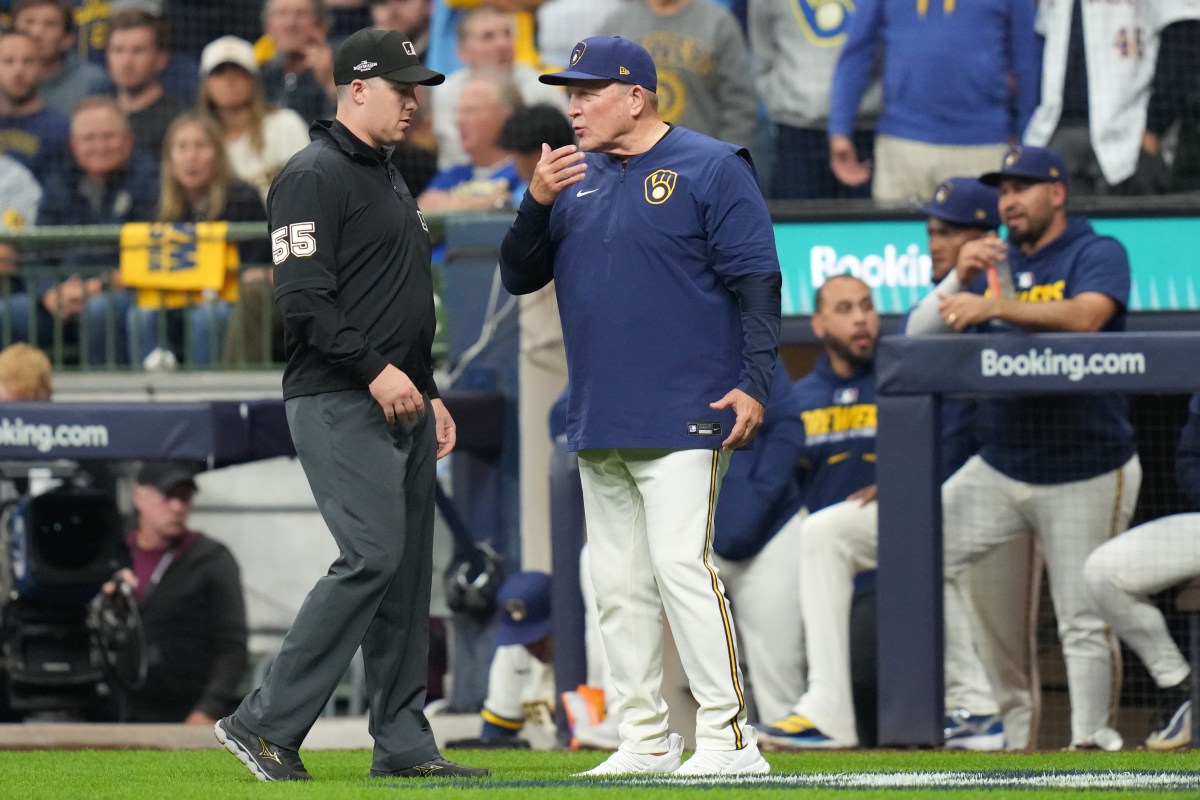
Ty France grabbed a wad of gum out of his mouth and threw it onto the field in disgust. The San Diego Padres first baseman thought he had hit a go-ahead home run in the ninth inning of a National League Division Series game against the Milwaukee Brewers on Saturday, Oct. 3. Instead, he hit into an out.
For that, he could only blame the roof of American Family Field. The retractable roof of the Brewers' domed stadium was closed for Game 1 of the best-of-five series. Miraculously for Milwaukee, it got in the way of France's fly ball, possibly preventing it clearing the fence with a runner on first base and the Brewers leading 3-2.
When the ball caromed off a rail high over left field, it came back on to the field, where Jackson Chourio caught it for an out. They ruled that it hit the roof fair, and the outfielder caught it. So, unfortunately, it’s a bad break for us.
Looked like it was a possible home run; just didn’t go our way.” Would it have been a home run if the ball hadn't hit the roof? It's impossible to say for sure. More news: MLB All-Star Who Came Back From Cancer Retires Immediately at 37 The ball did not appear to have reached its apex when it struck the rail, which was in fair territory at the point of contact.
Chourio didn't have much more room to drift back on the warning track in the left-field corner when he caught the ball. It wasn't hard to imagine the ball clearing the fence if the rail hadn't gotten in the way. On the other hand, baseballs hit fair at a 49-degree launch angle are rarely home runs.
According to Statcast, France's fly ball would have been a home run in only one of the 30 MLB stadiums — Daikin Park in Houston, where the left-field fence is shallower than any other big-league stadium. More news: Padres Rookie on Brink of 123-Year MLB Postseason History Balls hit at 49 degrees at 105 mph (like France's) almost always result in outs. The controversy was not whether the umpires got the call right, but whether a rule that allows the roof of a domed stadium to rob a home run is fair.
Extract — continue reading at the source.