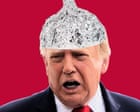
Since the start of his second presidency, Donald Trump has often launched outlandish conspiratorial attacks on critics and foes that mock them and label their views as hoaxes, prompting scholars and legal experts to say Trump’s attacks endanger US freedoms, public health and science. Trump’s extensive use of conspiracy theories is the hallmark of an authoritarian leader that has weakened trust in the coming midterm elections, dangerously ignored scientific evidence, and often pushed for prosecutions of his political enemies in ways that seriously erode civil liberties, say critics. Trump’s conspiratorial and authoritarian-style tactics are palpable say critics, in his false claim that the US faces a “crisis of election security” to bolster his radical push for new curbs on voting rights, and his labeling of climate change as a “hoax” despite extensive scientific evidence that it’s a reality.
To some scholars, Trump-backed conspiratorial claims have had a damaging impact on all levels of US society and democracy and are emblematic of how authoritarian leaders use conspiracies to justify repression. Steven Levitsky, the Harvard professor of government and the co-author of How Democracies Die, said: “Conspiracies are page one of the repressive playbook,” noting that Mao, Stalin, Putin and other authoritarian leaders have historically launched attacks on enemies by floating conspiracies. In a notable twist, Trump charged in mid-September that some AI leaders and experts were engaging in a big “conspiracy” and perpetrating a “HOAX”, by urging strong safeguards to protect against potential extinction-level threats to humanity from this powerful new technology.
Similarly, Trump without evidence disparaged critics of datacenters as people who “want to end up being backwards and poor”, and asserted he was the best “guardrail” to protect society from threats that unregulated AI pose. Scholars and former federal officials say that Trump’s tarring foes in conspiratorial attacks endangers democracy and recall the tactics of the infamous rightwing lawyer Roy Cohn, a key promoter of the “red scare” in the 1950s who Trump had close ties with in the 1980s during his early New York real estate career. In a Truth Social post on 21 September, Trump boasted that the White House “is instituting an assault on the FAKE NEWS, something that has grown like Cancer in our beloved United States of America.
It is corrupt, purposeful, pervasive, fully coordinated, and totally out of control. It is a threat to our National Security, and must be stopped, NOW!” A federal judge in DC ruled on 23 September that the administration should immediately return the press passes to the three outlets and its punitive action against them was probably unconstitutional. Former federal prosecutor Ty Cobb who was a special counsel in the White House during Trump’s first term, warned that “Trump denies, denigrates and demeans his foes by painting them as part of a conspiracy … He resorts to abject fabrications in response to any criticism or resistance.” This year Trump and his justice department have devoted sizable resources to bolster his conspiratorial claims that his 2020 loss to Joe Biden was due to fraud, and that the current voting system is riddled with fraud, notwithstanding overwhelming evidence to the contrary.
Trump has repeatedly pushed bogus claims laced with conspiracies as he did in a nationally televised speech on 16 July, when he urged tough new measures to curb voting by mail and investigate non-citizen voting ostensibly to make elections more secure. In the TV speech, Trump made the factually inaccurate claim that non-citizen voting, which is illegal and historically negligible, poses a “crisis of election security”. Trump’s obsession with painting non-citizen voting as a crisis is badly undercut by data from the conservative Heritage Foundation that cites just 100 cases over a 25-year period.
Critics see these moves by Trump to raise bogus fears about election safety and dark forces bent on voter fraud as a tool to “undermine public confidence” in the elections.
Extract — continue reading at the source.