sözaltı news World
World
EN AZ
Pakistan struck a rehab centre and killed 269 Afghans. Their families want to know why

Pakistan struck a rehab centre and killed 269 Afghans. Their families want to know why

bbc.com 12.05.2026 11:31 33 baxış
There are calls to investigate the 16 March airstrike - which the UN says likely killed more - as a war crime.

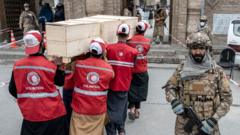
Their families want to know why Yogita LimayeSouth Asia and Afghanistan correspondentEPAOn a rainy, cold morning Masooda makes her way to a hillside cemetery in north-west Kabul to visit the grave of her younger brother Mirwais.But she doesn't know exactly where he was buried after he was killed in a Pakistani airstrike two months ago.Instead, she stands at the edge of a mass grave, neatly covered with tiny white stones and roughly marked with grey granite slabs, which is the final resting place of some of the at least 269 people killed in the attack on a drug rehabilitation centre.Exactly how many are in the grave is impossible to say: like Mirwais, who was 24, many were barely identifiable – reduced to body parts or burned beyond recognition."My brother's body was in pieces. There was barely anything left of him to give us," says Masooda, 27, breaking down as she speaks. "They just found his torso.

I identified it through a birthmark he had."The attack on the Omid Drug Rehabilitation Hospital is the deadliest attack in Afghanistan, possibly ever, but certainly in recent history, including 20 years of war between the Taliban, and Nato and Afghan republic forces.A report released on Tuesday by the United Nations puts the number they can confirm at 269, but acknowledges the real figure is likely to be significantly higher.There are calls for the attack to be investigated as a war crime.The faces of some of the men killed in the strike on 16 MarchFighting between Pakistan and Afghanistan has been going on for months, leaving hundreds dead, most of them from Pakistani airstrikes. Islamabad accuses the Taliban government of sheltering militants who attack Pakistan. Kabul denies doing so.The carnage at the drug rehab centre accounts for most of those killed in the fighting this year.

The scale of the death toll is so staggering it has shocked Afghanistan, despite its long familiarity with violent conflict.The UN, which was given access to the site, as well as the BBC's Afghan service teams who were on the ground in the immediate aftermath, confirm the strike hit civilians undergoing treatment. Human Rights Watch called it "an unlawful attack and a possible war crime".But Pakistan disputes it hit a civilian target. In a statement to the BBC it said that "no hospital, no drug rehabilitation centre, and no civilian facility was targeted", adding: "The targets were military and terrorist infrastructure."Masooda is angered by the claim."Pakistan is lying.

I have seen it and it wasn't a military camp. There were men admitted there who had come to get healed and return to their families," says Masooda.She is not alone. The BBC has spoken to the families of more than 30 victims – including those of recovering addicts, and employees of the centre - who reject Pakistan's claims.Masooda doesn't know exactly where her brother is buried - he is one of scores placed into the mass grave behind herOmid centre may be located in a former military training compound called Camp Phoenix, which used to be used by the US and Nato forces, but it is far from new.Opened in 2016, after the Americans abandoned the base and five years before the Taliban seized power in 2021, Omid was well-known and had been widely covered by domestic and international news outlets.The BBC had been given access inside the facility in 2023 to speak to recovering addicts."It's literally about a kilometre away from the main UN offices.

We have UN agencies, support to the patients of that hospital. So the site was well known to us," said Fiona Frazer, the representative of the UN High Commissioner for Human Rights in Afghanistan.Mirwais – one of an estimated three million Afghans struggling with drug addiction – was one of the newest inpatients.Masooda, who had raised him like a son after the death of their parents, revealed he had been studying to be a pharmacist when he got addicted to 'Tablet-K', the street name of a synthetic drug which, depending on its type, can contain methamphetamine, opioids or MDMA."He was a simple boy who got into a bad habit. He had only been at Omid for 10 days when this happened," Masooda says.The three bombs fell on the facility located on the Kabul-Jalalabad highway at about 20:50 local time on 16 March, one of the doctors on duty at the time told the BBC.

He didn't want to be identified because he hadn't been authorised to speak by the Taliban government."One of them hit a hangar-like structure where newly-admitted patients are normally housed," he said."The other two bombs hit containers and wooden blocks that housed patients, as well as food storage units, and offices of the administrative, security and support staff."The UN's Fiona Frazer points out that it also struck "the vocational training areas within the hospital, which were buildings that were mostly made of wood, which then resulted in this very, very large fire".The UN's report into the attack noted that the "leading cause of harm to those killed and injured was shrapnel wounds and burns". It added that "several bodies were unable to be identified because of the nature of their injuries or because they were reduced to dismembered body parts"."I have never seen such a horrific scene in my life," the doctor continued. "I walked amid dead bodies looking for anyone who was alive, looking for people who were screaming for help.

Extract — continue reading at the source.

Read full story