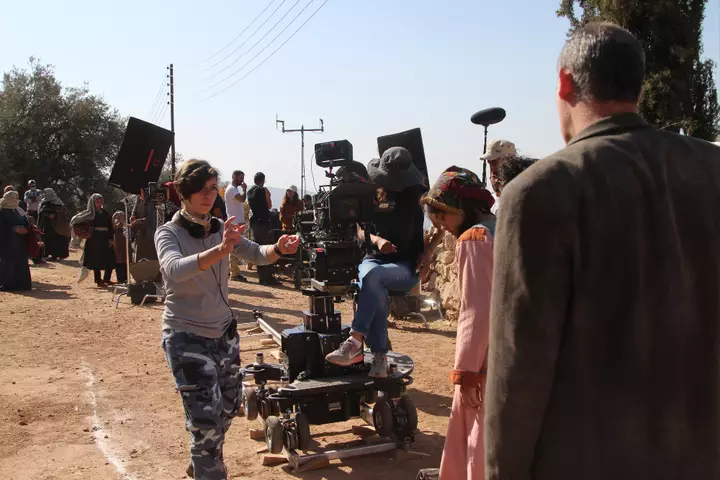
Sallam has no regrets about making “Farha,” her debut feature about a Palestinian girl coming of age during the Nakba, the mass displacement and dispossession of Palestinians surrounding the creation of the state of Israel in 1948. The film sparked controversy that Sallam was warned could derail her career before it had properly begun. Festival for Children and Youth.
The film premiered at the Toronto Film Festival in 2021, was later selected as Jordan’s submission for the international feature Oscar and subsequently streamed globally on Netflix. Its Netflix release prompted a fierce backlash, particularly over a scene depicting Israeli soldiers killing a Palestinian family. Israeli officials publicly condemned the film, while Sallam and others involved with it faced harassment and online abuse.
Sallam has also been unable to travel to Palestine since the film’s release. The warnings rolled in even before the film was shot. For Sallam, the film grew out of a broader conviction that history is most powerful when experienced through individual lives.
Sallam sees personal and collective memory as inseparable, with Farha’s journey distilling an event that transformed thousands of lives into an experience audiences could encounter through a single character. Only then can it move beyond delivering messages and become something that truly touches people, challenges them and stays with them.” Sallam is again turning toward women and history with “Churching of Women,” her second feature. Set in the Levant, encompassing present-day Palestine, Lebanon, Syria and Jordan, in 1938, the film follows Fadia, a pioneering female author grieving the loss of her parents who turns to her cousin for support, only to be confined against her will in a mental asylum while he seizes her inheritance.
The project took part in the Busan Intl. Film Festival’s Asian Project Market in 2025 where it won the ArteKino International Award. It is now in advanced development and financing.
It began with an idea about injustice that stayed with Sallam. While she remains committed to telling stories about women whose voices have been suppressed, Sallam says the new film will allow her to explore injustice, grief, women supporting one another and colonial power structures in the region. Together with her producers, Sallam is considering what they learned from the film’s production, release and distribution, and how that knowledge can serve the journey of “Churching of Women.” What it has not done is make her more cautious about the stories she chooses to tell.
Extract — continue reading at the source.