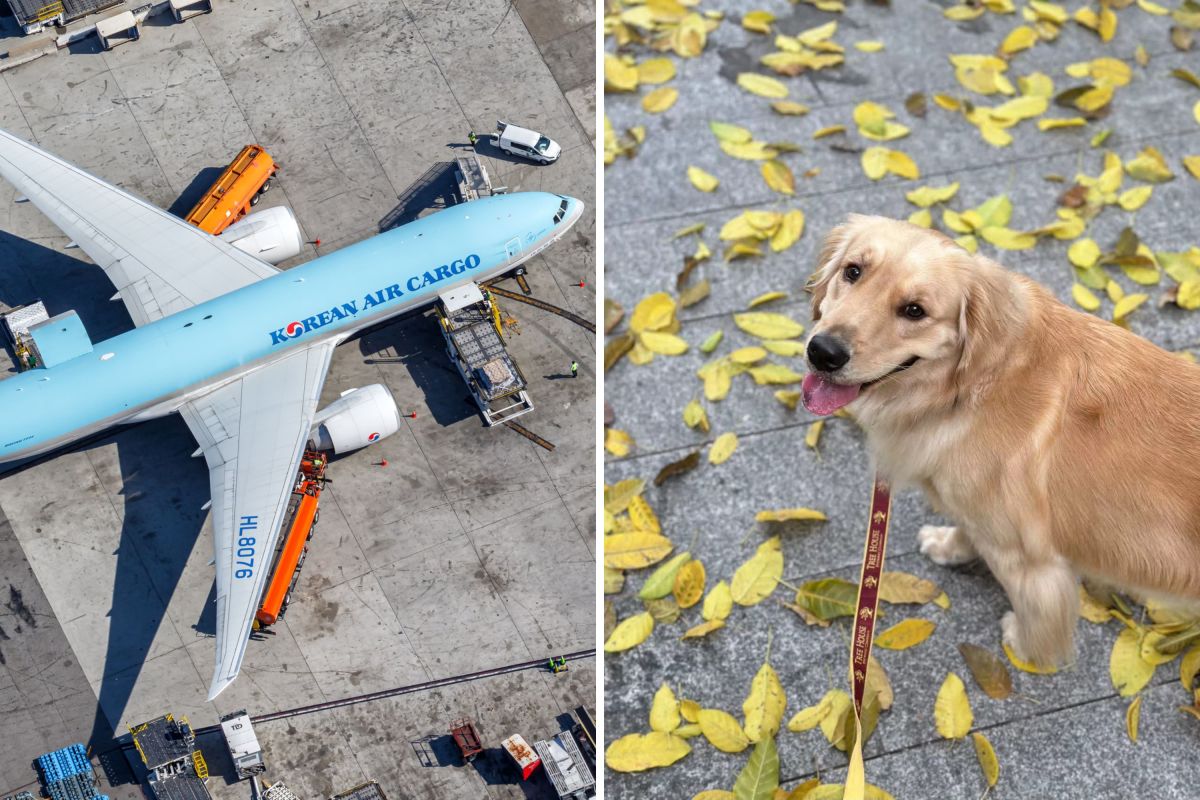
A woman is seeking answers after her dog, Bubble, was found dead in her crate following a Korean Air flight from Guangzhou in China to Incheon in South Korea. Bubble died after traveling in the cargo hold on Korean Air flight KE 868 on September 3. The dog's owner, Jennifer, together with animal travel advocacy group FlyTogether.org, has since launched a petition on Change.org calling for greater transparency about what happened during the journey and to push for answers.
Sharing an image of Bubble's body in her carrier in a September 4 post on Threads, Jennifer (@jenn_jwww) wrote: "Korean Air, I handed you my little girl alive. You returned her body to me. I was in the same airport looking for her, while nearly two hours of her final journey remain unexplained.
Please help me find out what happened to Bubble." A spokesperson for Korean Air told Newsweek the airline had verified that conditions aboard the aircraft were operating normally. "We extend our deepest sympathies to the customer for the loss of their beloved pet," the spokesperson said. "Upon arrival of flight KE 868 from Guangzhou to Incheon, the dog was found deceased in its crate." Jennifer explained that Bubble was an "experienced traveler who had flown in the cabin with me before,” but had to travel in cargo on the Guangzhou-to-Seoul leg because she was a large dog.
The plan was for Bubble to rejoin her in the cabin on the following flight to Los Angeles. "I paid nearly $4,000 for business class, plus around $300 for her transport," Jennifer wrote on Threads. "This was never about saving money or not caring enough." Newsweek has contacted Jennifer via Threads and Instagram.
The recent incident comes amid ongoing concern about pet travel. Department of Transportation's Air Travel Consumer Report published in August, there were nearly 100 complaint cases related to animals and pets, excluding service animals, during the first six months of 2026, including 64 involving U.S. airlines and 29 involving foreign carriers. The International Air Transport Association (IATA) explains that while many pet owners prefer in-cabin travel, larger animals often must be transported in cargo holds.
The IATA notes that "despite all the fears about airline pet cargo travel, millions of animals are carried safely every year." The organization adds that "cats and dogs actually travel better this way because it is quieter and they will rest in a darkened environment." A spokesperson for Korean Air told Newsweek: “We verified that all environmental control systems essential for animal transport functioned normally throughout the flight, and all other pets traveling on the same flight arrived safely without incident.” According to a screenshot of a statement previously posted by Korean Air as a story on the airline’s Instagram account, which was shared with Newsweek by Sonia Aguado, the founder and head of FlyTogether.org, the airline said at the time: “Our team communicated with the customer on the day of arrival to share the available information.” The airline’s spokesperson told Newsweek: “We are currently communicating directly with the passenger to address her additional inquiries. Out of respect for the customer, it would not be appropriate for us to share further specific details, evidence, or internal records publicly through the media. We remain committed to transparent communication directly with the passenger.” Jennifer maintains that she is not accusing Korean Air without evidence, but says she cannot accept conclusions based solely on environmental controls and the safe arrival of other animals.
Extract — continue reading at the source.