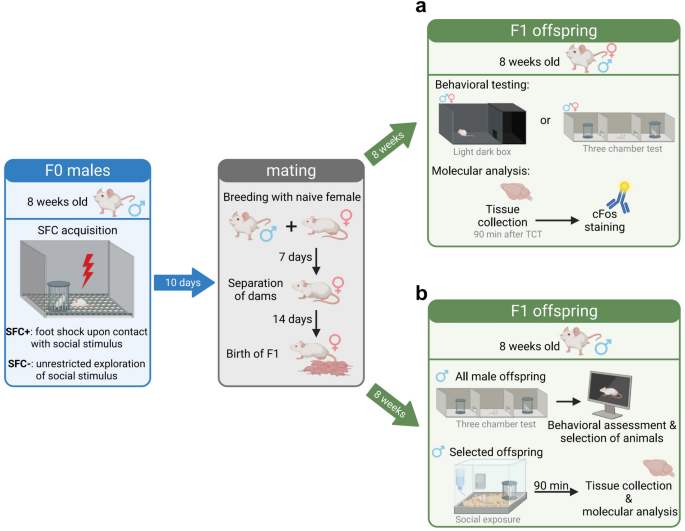
The intergenerational transmission of traumatic experiences is increasingly recognized as a contributor to behavioral and neurobiological vulnerability in offspring. However, the inheritance of paternal traumatic social experiences remains poorly understood. Here, we employed the social fear conditioning (SFC) paradigm in mice to investigate the transmission of paternal socially aversive experiences to the next generation.
First, we confirmed that social fear acquisition selectively impaired social approach behavior without affecting locomotion or general anxiety-related behavior in adult male mice of the F0 generation. Second, we examined the consequences of F0 paternal social fear conditioning for first-generation (F1) offspring. We found that male but not female F1 offspring of conditioned (SFC+) fathers displayed reduced sociability.
This behavioral alteration was accompanied by increased cellular activity in the lateral septum, as indicated by elevated cFos expression. Finally, exploratory transcriptomic analyses within the septum revealed that social fear acquisition was associated with an overall upregulation of synaptic plasticity-related genes in SFC+ F0 males compared to SFC− F0 controls. Remarkably, this transcriptomic profile was inverted in F1 male offspring of conditioned fathers, who displayed relative downregulation of the same synaptic plasticity-associated genes.
Notably, six genes (Adcy8, Cdh2, Mapk1, Nptx2, Plcg1, and Srf) were significantly upregulated in F0 males but downregulated in F1 male offspring. Together, our findings establish the SFC paradigm as a selective and robust approach to study the intergenerational transmission of paternal traumatic social experiences. Moreover, they reveal specific gene expression changes associated with social behavior that may underlie behavioral deficits in the next generation, thereby highlighting molecular targets for future studies.
Traumatic experiences can exert long-lasting effects beyond the directly exposed individual, influencing behavioral, physiological, and neuronal outcomes in subsequent generations. Human studies suggest that parental trauma, including exposure to war1, famine2,3, or severe emotional stress4 is associated with increased risk for stress-related disorders in descendants. Complementary rodent studies demonstrate that parental stress exposure can alter offspring behavior, stress responsivity, and gene regulation, providing a biological basis for intergenerational inheritance5,6,7.
Collectively, these observations indicate that traumatic experiences leave enduring biological traces that affect offspring phenotypes, even in the absence of direct exposure. However, the specific information transmitted across generations and whether it reflects parental experience rather than generalized stress vulnerability remain unclear. Importantly, intergenerational stress effects have been demonstrated across a wide range of experimental paradigms, including both early-life stress and adult stress exposure models.
Extract — continue reading at the source.


