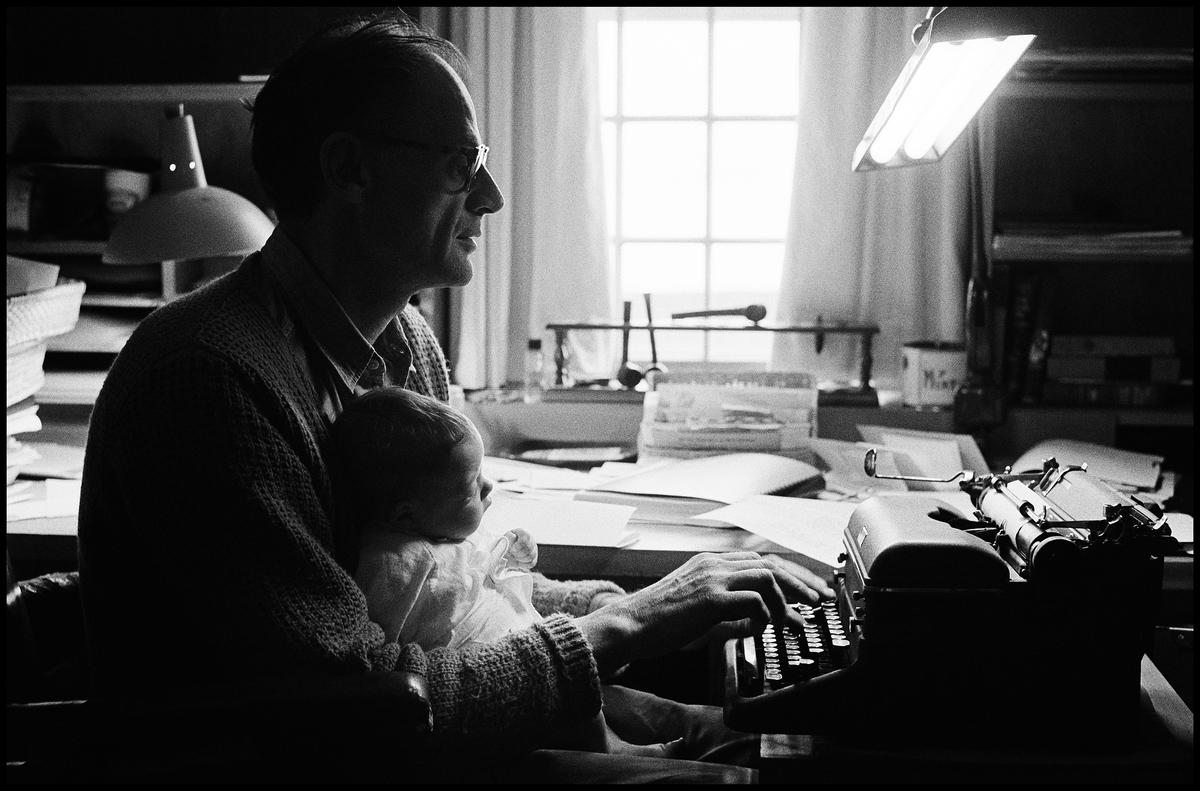
Arthur Miller with his daughter Rebecca in 1962 in Roxbury, Connecticut, US. Photo by Inge Morath/Magnum Here’s an old story, often told. In Book 6 of the Iliad, Hector – dressed splendidly in bronze armour and a helmet with a horsehair crest – bids farewell to his wife Andromache.
She begs him not to return to battle and hands him their newborn son. Hector raises the boy into the air, says a short prayer, and hands him back. Few were shocked when the painter Paul Gauguin left his wife and five children in Denmark to pursue fame and art in Paris, then Tahiti.
Such distance, they say, is good for a child. This is a deeply self-serving story, of course. It’s nice for the male poet not to have to change diapers.
But the argument that unsullied privacy is essential to creativity is tenacious. It surfaces when Virginia Woolf writes that ‘a woman must have money and a room of her own if she is to write fiction.’ Contemporary feminists have continued to respond to this archetype of generativity. In Jenny Offill’s novel Dept. of Speculation (2014), for example, the narrator vows never to marry but to become ‘an art monster instead’.
But what if domesticity – and specifically parenthood – is in fact generative for artists? What if the cliché of solitary male creativity got it wrong? We may begin with one nursing poet.
In his poem ‘Frost at Midnight’, written in the winter of 1797, Samuel Taylor Coleridge pictures himself at home in his cottage on a frosty night. The owls cry outside and the frost rings the trees and he is alone, ‘save that at my side / My cradled infant slumbers peacefully.’ He addresses his infant son: He is transported to memories of his own childhood, and then his hopes for his son’s future. As such, it is a surprising poem about domestic labour, which has invited comment from scholars.
Extract — continue reading at the source.