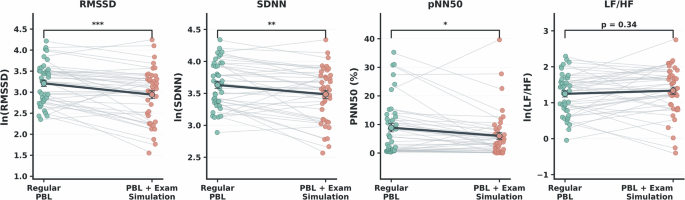
Repeated problem-based learning (PBL) sessions are intended to sustain active, collaborative, and self-directed learning, yet evidence is mixed as to whether familiar PBL routines consistently maintain an appropriate level of learner activation over time. This repeated-measures study examined whether embedding a peer-led examination simulation into regular PBL reshapes psychophysiological and achievement-emotional state profiles. Forty-two medical students were assessed during resting reference, regular PBL, and PBL with peer-led examination simulation.
Heart rate variability (HRV) was quantified using RMSSD, SDNN, pNN50, and LF/HF, alongside anxiety, perceived stress, achievement emotions, motivation, self-rated performance, and post-session appraisal. Both PBL formats reduced HRV relative to rest, indicating autonomic activation during regular PBL itself. Compared with regular PBL, examination simulation produced additional HRV withdrawal, higher anxiety and perceived stress, and lower boredom.
Baseline-adjusted mixed models supported effects for RMSSD and SDNN; pNN50 did not survive false-discovery-rate correction, and LF/HF showed no robust effect. Enjoyment, motivation, and self-rated performance did not differ significantly. Students reported greater perceived benefit from and stronger preference for the simulation format.
Peer-led examination simulation thus shifted PBL toward a more salient, assessment-like psychophysiological and emotional state profile. Problem-based learning (PBL) is an established instructional approach in medical education that organizes learning around authentic, complex problems rather than around the passive reception of discipline-based content1,2. In PBL, students typically work in small groups to activate prior knowledge, identify knowledge gaps, formulate learning objectives, engage in self-directed inquiry, and collaboratively integrate new knowledge into a shared understanding of the problem3.
Originating from curriculum reform in medical education, most prominently at McMaster University, PBL was developed to bring learning closer to the intellectual demands of clinical reasoning and professional practice4,5. Its enduring appeal lies in a simple but powerful premise: medical knowledge is learned most meaningfully when it is actively constructed, negotiated, and applied in context. Conceptually, PBL builds on constructive, self-directed, collaborative, and contextual learning principles and is therefore considered particularly suited to strengthening clinical reasoning, problem-solving, and professional competencies6,7.
In many medical curricula, however, PBL is not necessarily implemented as the sole organizing principle of the entire program, but rather as a deliberately embedded small-group format within broader undergraduate or preclinical teaching structures. This makes individual PBL sessions important curricular spaces in which selected biomedical or clinically oriented content can be transformed into problem-oriented, student-centered learning. Yet the promise of PBL is not automatically realized once students are placed around a problem.
Extract — continue reading at the source.


