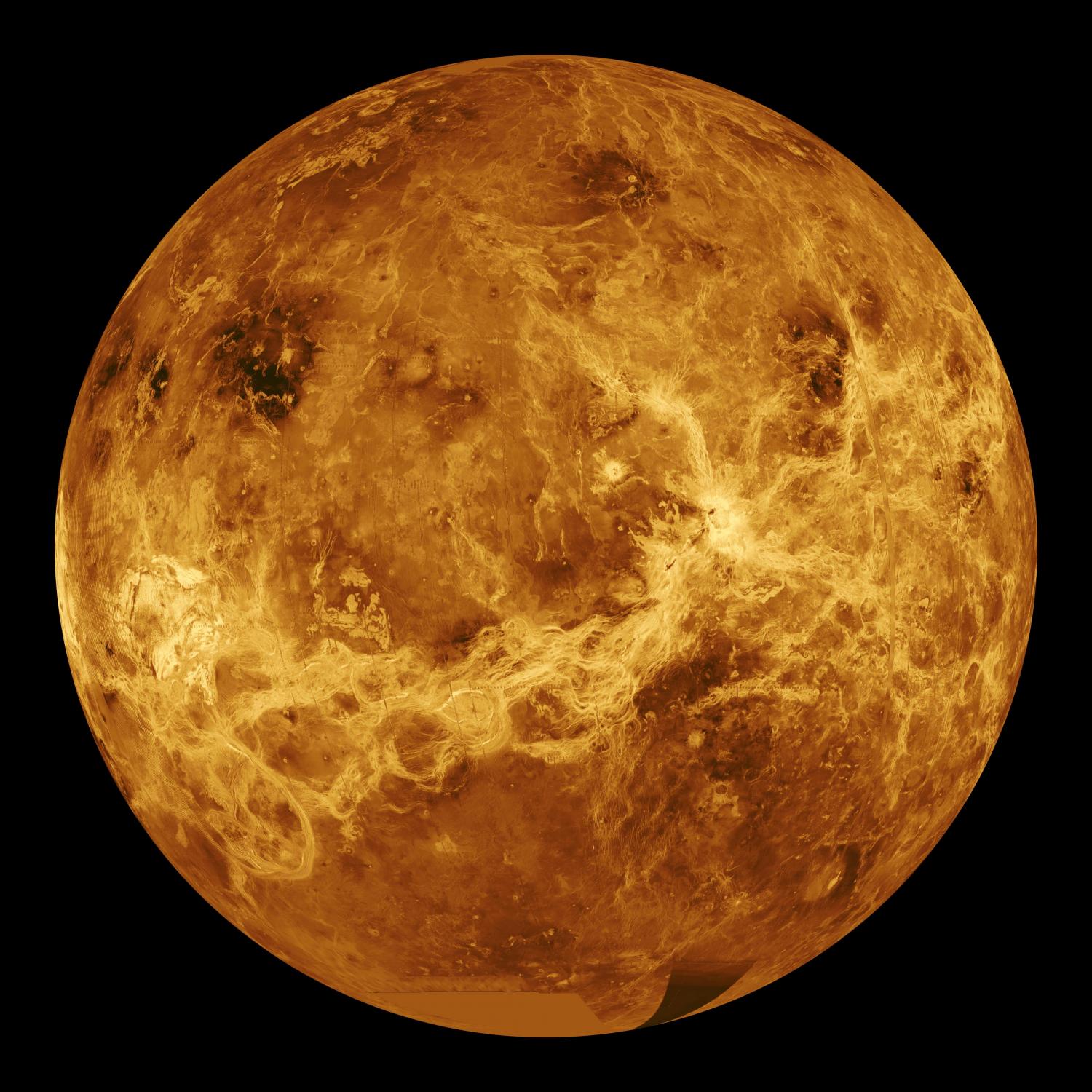
This article has been reviewed according to Science X's editorial process and policies. Editors have highlighted the following attributes while ensuring the content's credibility: When exploring solar system bodies for signs of past or present life, scientists have mainly focused on planets that have (or had) a liquid surface similar to Earth's. However, mounting evidence suggests that the ingredients for life may exist in a very different environment: the highly acidic clouds that blanket Venus.
Those clouds are made up of about 98% sulfuric acid, which scientists had believed to be too acidic for complex biological molecules to survive. But in a new study, MIT researchers have shown that short peptides can not only remain stable in these extremely acidic conditions, but also fold into shapes that may allow them to have biological functions. "If peptides find their way to that cloud layer of concentrated sulfuric acid, they will stay and be stably preserved in that cloud of droplets.
And once these macromolecules have a defined three-dimensional structure, they can potentially have a function," says Mei Hong, a professor of chemistry at MIT and one of the senior authors of the new study. The findings suggest that scientists should not rule out planets that don't resemble Earth in their search for life, says Sara Seager, the Class of 1941 Professor of Planetary Sciences in the Department of Earth, Atmospheric and Planetary Sciences and a professor in the departments of physics and aeronautics and astronautics. "We really don't know the full extent of what planetary archetypes are out there.
We're seeking exoplanets that might be a true Earth twin, but what if they're all Venuses? Our findings definitely open up a whole range of possibilities," says Seager, another senior author of the study. She will be joining the University of Toronto faculty in September.
Janusz Petkowski, a research assistant professor at Wroclaw University of Science and Technology, is also a senior author of the paper, which appears this week in the Proceedings of the National Academy of Sciences. Jia Yi Zhang, an MIT graduate student, is the paper's lead author, and former MIT postdoc Aurelio Dregni is also an author. While Venus's surface is too hot to be hospitable to life, its cloud layer, which extends from 30–40 miles (48–64 kilometers) above the planet's surface, features milder temperatures suitable for life.
The clouds are made from droplets of sulfuric acid, which can dissolve metals and destroy most biological molecules on Earth. Meteorites that contain peptide building blocks regularly enter Venus's atmosphere, raising the possibility that those peptides could serve as building blocks for simple life forms—if they could survive the clouds' corrosive environment. In 2020, Seager's lab began a series of studies looking at whether different types of biological molecules could persist under those highly acidic conditions.
Extract — continue reading at the source.