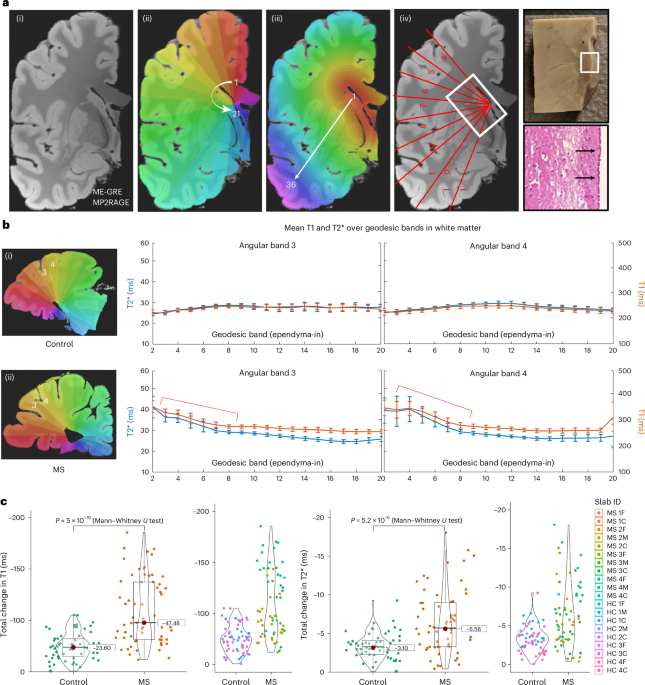
Cerebrospinal fluid (CSF)-adjacent brain areas are especially vulnerable to diffuse degeneration in multiple sclerosis (MS). Surface-in gradients arising from CSF-borne cytotoxic factors have been proposed to predict disease relapses independent of white matter lesions. Yet, whether such factors disrupt ependymal cells to penetrate the ventricular border in MS remains unknown.
Here, using ultra-high-field magnetic resonance imaging-guided histology, electron microscopy and single-nucleus multiomics, we found that ependymal pathology correlates with periventricular gradients and involves an immune-reactive state marked by transporter and junctional protein dysregulation. We further defined the gene regulatory networks underpinning the MS ependymal state and predicted ligands known to be enriched in MS CSF that could drive the emergence of this state. One of the candidates, IFNγ, increased murine ependymal permeability in vivo, indicating that CSF ligands can modulate ependymal function and regional inflammation.
These findings identify CSF-driven ependymal dysfunction as a contributor to periventricular pathology in MS. This is a preview of subscription content, access via your institution Access Nature and 54 other Nature Portfolio journals Get Nature+, our best-value online-access subscription Receive 12 print issues and online access Prices may be subject to local taxes which are calculated during checkout Our single-nucleus multiome data are deposited on GEO (GSE283715) and have been uploaded to our open science website SingloCell for further analysis: https://singlocell.openscience.mcgill.ca/display?dataset=RNA_Hu_Nervous_CTRL_MS_Ependymal_snRNA_2026 (single-nucleus RNA-seq ependymal dataset); https://singlocell.openscience.mcgill.ca/display?dataset=RNA_Hu_Nervous_CTRL_MS_Ependymal_RNA_ATAC_TF_AUC_2026 (single-nucleus multiomic sequencing ependymal dataset). Source data are provided with this paper.
All code used to analyze ex vivo MRI images and single-nucleus RNA-seq and ATAC-seq data is available on GitHub: https://github.com/stratton-lab/groh-2025-periventricular/. A., Kuhlmann, T. & Antel, J. The role of glial cells in multiple sclerosis disease progression.
Neurol. 18, 237–248 (2022). Mechanism-based criteria to improve therapeutic outcomes in progressive multiple sclerosis. Neurol. 18, 40–55 (2022).
Multiple sclerosis pathology. Med. https://doi.org/10.1101/cshperspect.a028936 (2018). A gradient of neuronal loss and meningeal inflammation in multiple sclerosis.
Extract — continue reading at the source.