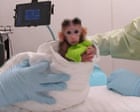
Footage released by the animal-rights group Peta reveals, for the first time, filmed experiments at the University of Washington’s National Primate Research Center (WaNPRC), in which newborn monkeys were separated from their mothers and subjected to neurological tests after prenatal exposure to a neurotoxin. Records show that the infant monkeys, some just two days old, were used in research on domoic acid, a toxin produced by marine algae that accumulates in shellfish and can cause illness in humans. The experiments were part of a project that ran for six years until 2020.
The footage shows monkeys with electrodes attached to their heads, undergoing tests to investigate whether exposure to domoic acid in the womb had damaged their brains. The baby monkeys appear distressed as they clutch blankets, suck their fingers, screech, and jerk as experimenters shave their heads and test their reflexes and memory. The infant macaques were bred at the University of Washington’s Infant Primate Research Laboratory for the project researching the developmental neurotoxicity of domoic acid in nonhuman primates.
Researchers administered doses of domoic acid daily to 32 pregnant macaques. After birth, 28 infants were removed from their mothers, bottle-fed and kept in incubators before being housed individually at three weeks old. In the wild, macaques live in close social groups.
Infants have long-term maternal care needs for their social and behavioral development, says Dr Malene Hansen, a long-tailed macaque expert, and cannot thrive without their mothers. The WaNBRC told the Guardian: “We recognize that research involving infant animals raises important questions about their wellbeing. Maternal relationships and early social development are important considerations in nonhuman primate welfare.
Our experienced veterinary and animal care personnel have specialized expertise in primate care, including nursery rearing.” The project ran from 2014 to 2020 and received more than $4.2m in National Institutes of Health (NIH) funding. Some experiments lasted years. According to Peta, the monkeys were killed after the experiments were concluded.
The NIH says it takes the care and use of laboratory animals very seriously: “All animals used in NIH-supported research are protected by laws, regulations and policies designed to ensure the smallest possible number of animals are used and their welfare is prioritized.” According to the WaNBRC, there are no current infant studies at its center; however, protocols for such studies are active. Jones-Engel says: “There is no moral escape hatch. You can’t claim primates are used because they’re so like us, then take an infant away from its mother and experiment on it.
Extract — continue reading at the source.


