The track marks have dried in the mud beside Peter Giesel’s unmarked grave. The digger is long gone, although other signs of work remain. A stretch of earth where the soil is yet to settle, sandwiched between an old set of headstones and a dirt walkway at Sydney’s Rookwood general cemetery.
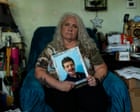
Nothing tells you Giesel is here – no headstone, cross or plaque. There’s no sign that the New South Wales government buried him in this grave with three others on a single day in late June, four strangers united only by the plot they share. Giesel’s sister, Nicole, is confused and devastated after belatedly learning that her older brother had been put in an unmarked communal grave.
So is his close friend Elaine Grady, who would spend hours each day on the phone to Peter from the US, joking and laughing, sharing pictures of American cars, and dreaming up plans for the out-of-work mechanic to escape his difficult life in Australia. Giesel’s plot sits in a row of nine unmarked graves dug in the first half of this year to hold people the NSW government has designated “persons without means” – those unable to afford their own funerals. The designation gives the state control over the handling of their remains, leading to about 98 burials, 293 cremations and 22 ash interments each year.
A Guardian Australia investigation has found that the process is sending hundreds of poor and vulnerable Australians into unmarked communal graves like Giesel’s, which typically hold four to six people each. The three-month investigation, encompassing evidence from family, friends and support workers alongside analysis of cemetery records and aerial and satellite imagery, has also identified serious failures that are putting people into unmarked graves unnecessarily. In six cases uncovered by the Guardian, friends, community leaders and family were either not told of the use of unmarked communal graves or not given a proper chance to intervene and pay or crowdfund for a proper burial or marker, a likely breach of government policy.
Guardian Australia has also discovered that at least 18 individuals known to Sydney homelessness services have been placed in the unmarked graves since 2016. In one case, the rough sleeper Roger Davies was put in a grave with four strangers without his sister’s knowledge because police lacked her current contact details. His sister, Chantel Dubsky, was alive and well in Adelaide, and would have paid for her brother’s cremation and repatriation.
She describes the failing as “unspeakable”. Prominent leaders in Sydney’s homelessness sector are outraged by the revelations, saying they were not informed about the use of unmarked communal graves and were never given the chance to intervene and pay for proper burials for clients or former clients. Both served in the Royal Australian Navy.
Extract — continue reading at the source.