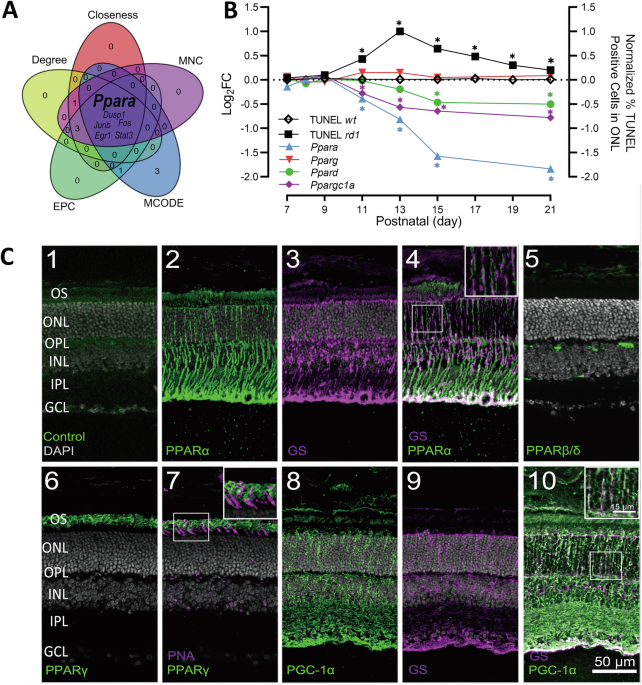
Retinitis pigmentosa (RP) is a group of inherited diseases characterized by primary rod photoreceptor dysfunction and progressive cone cell death. Due to their very high energy demand, the degeneration of photoreceptors may be linked to insufficient energy supply or metabolic imbalance. Critical transcription factors that regulate metabolism, such as peroxisome proliferator-activated receptors (PPARs) and PPAR gamma coactivator 1α (PGC-1α), have been found to play important roles in neurodegenerative diseases, but their potential roles in RP have yet not been elucidated.
Here, organotypic retinal explant cultures derived from retinal degeneration 1 (rd1) mice were used to investigate the effects of PPARα, PPARγ, PPARβ/δ agonists, as well as PGC-1α activation and inhibition. Photoreceptor death was quantified using the TUNEL assay, while in situ activity assays were used to monitor effects of PPARs and PGC-1α on poly (ADP-ribose) polymerase (PARP) and calpain activity. Generation of poly (ADP-ribose) (PAR) and activation of calpain-1 and calpain-2 were evaluated by immunostaining.
PGC-1α/PPAR-associated transcriptional changes were assessed by RT-qPCR. We found that PPARβ/δ agonists had limited effects, while treatment targeting PPARα, PPARγ, and PGC-1α significantly reduced photoreceptor death and PARP activity in rd1 retina. RT-qPCR analysis in treated rd1 retina confirmed upregulation of genes downstream of PGC-1α/PPAR signaling.
Stimulation of the histone deacetylase sirtuin-1, an upstream regulator of PGC-1α, had no beneficial effect on photoreceptor viability unless combined with PARP inhibition. Furthermore, PPARγ and PGC-1α effectively suppressed overall calpain activity and overactivation of calpain-2, alleviating photoreceptor degeneration caused by Ca2+ imbalance. In summary, our data support the concept of a PARP–sirtuin-1–PGC-1α–PPAR–PARP feedback control that connects defective energy metabolism to photoreceptor degeneration.
Specifically, our findings suggest that PPARα, PPARγ, and PGC-1α cooperate to preserve photoreceptor viability, highlighting PPAR-signaling as a promising target for future therapeutic interventions. The authors would like to thank Norman Rieger (from Institute for Ophthalmic Research, Eberhard-Karls-Universität Tübingen) for excellent technical assistance. We acknowledge support from the Open Access Publication Fund of the University of Tübingen.
This work was funded by the Charlotte and Tistou Kerstan Foundation, the China Scholarship Council (CSC), the Yunnan Xingdian Talent Program for Young Talents, the Yunnan Provincial Health Commission Clinical Medicine Center Research Project (Nos. 2024YNLCYXZX0326 and 2024YNLCYXZX0339), the Yunnan Fundamental Research Kunming Medical University Projects (No. 202501AY070001-217), the Young Doctoral Program of Yunnan University (YDYXJJ2025-0056), the Yunnan University Medical Research Foundation (YDYXJJ2024-0004), the National Natural Science Foundation of China (No. 82260213), and the Yunnan Fundamental Research Projects (No. 202605AO120007). Open Access funding enabled and organized by Projekt DEAL. Cell Death Mechanism Group, Institute for Ophthalmic Research, University of Tübingen, Tübingen, Germany Graduate Training Centre of Neuroscience, University of Tuebingen, Tübingen, Germany Yunnan Eye Institute & Key Laboratory of Yunnan Province, Yunnan Eye Disease Clinical Medical Center, Affiliated Hospital of Yunnan University, Yunnan University, Kunming, China Lan Wang, Jie Yan, Zhulin Hu & Kangwei Jiao Departamento de Anatomía y Fisiología, Facultad de Medicina y Ciencias de la Salud, Universidad Católica de Valencia San Vicente Mártir, Valencia, Spain Department of breast surgery of The Third Affiliated Hospital of Kunming Medical University, Yunnan Cancer Hospital, Peking University Cancer Hospital Yunnan, Kunming, China Division of Ocular Neurodegeneration, Institute for Ophthalmic Research, University of Tübingen, Tübingen, Germany Correspondence to François Paquet-Durand.
Extract — continue reading at the source.


