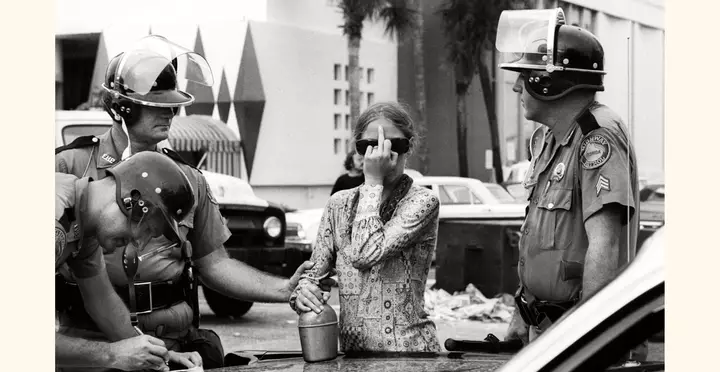
This deeply personal project—Rebels with a Cause—is a photographic book that captures the 1960s, a formative period of American history when groups of rebels initiated a series of changes and started a revolution unlike any other. The book is our love letter to the heroes and heroines who changed America and allowed Jean-Pierre and I to document it. It is an ode to those who fought for a better world not just with force or power, but with spirit, music, courage, and imagination.
When we arrived in the United States in 1965, America was in the middle of profound turmoil. The youth of the country, along with some dreamers and fighters, were the ones pushing it forward little by little. We began documenting this change.
The streets and campuses were loud with protests, but there was a palpable feeling of hope, enthusiasm, and joy. There was tragedy as well, and we lived through the murderous year of 1968 when Robert Kennedy campaigned to be the next President and Martin Luther King was shot dead in Memphis. On April 22, 1970, we went together to the first Earth Day in New York, when thousands of mostly young people filled the streets to demand protection for the planet.
It was striking to see environmental concern emerge as a form of activism, driven by the same generation that was questioning war, politics, and the future itself, reinforcing the idea that protest could be thoughtful, creative, and deeply constructive. We saw the counterculture emerge as a significant social movement. We saw students march against the Vietnam War, four of whom were shot dead at Kent State University, and to represent their suffering, a young man strapped himself to a crucifix.
We saw veterans occupy the Statue of Liberty where the American flag was turned upside down, a poignant symbol of resistance. At Watkins Glen, we saw hundreds of thousands of hippies dancing in the rain, sleeping in fields, making love, and sharing what they had. The hippie generation is gone now but has impacted our ways of life in profound ways.
At the same time we followed the women’s movement [see photos below] as it grew, fighting for change and struggling for equality, pushing back on the expectations placed on them. Our first encounter with the LGBTQ+ community came in 1965, when two young trans people asked Jean-Pierre to take their picture. They invited him into their building on West 65th Street and introduced him to their friends.
Extract — continue reading at the source.