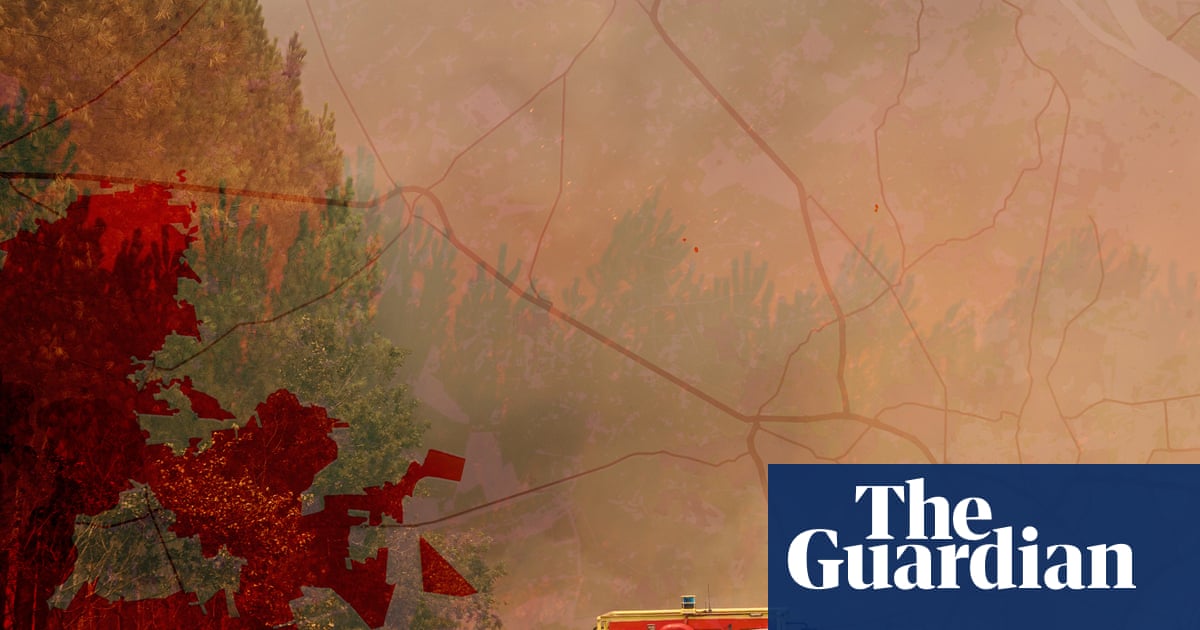
The ruinous fires that overran parts of France this summer have burned more land than ever recorded, forced more people from their homes than at any point since the second world war and caused what scientists suspect is the country’s first firestorm thundercloud. The smoke from France’s biggest inferno in nearly 80 years choked Limoges, a city 125 miles (200km) from the flames, with more toxic dust than Delhi residents inhaled on the city’s worst day of smog last year. The blaze that tore through forests outside Bordeaux in late July took just a few weeks to reforge France’s relationship with fire, but the conditions behind it were centuries in the making.
In the 18th century, the coastal wetlands of south-western France were so swampy that shepherds used stilts to cross them in winter. When a 1857 decree from NapoleonIII forced landowners to drain the marsh and populate it with maritime pines, the water-logged landscape was converted into Europe’s largest human-made forest. It has since become a regional economic engine running on timber that employs 30,000 people.
It is also a firefighter’s nightmare. The pines that make up 90% of the trees in the Landes forest hold resin that burns like petrol, needles that carpet the ground with flammable material and cones that whiz in the wind like grenades, spreading flames across breaks in vegetation that should act as barriers. Without the diversity offered by broad-leafed species, which retain more moisture and have shady canopies that stop vegetation from drying, the dense monoculture can burn with fury when sparks catch.
That is what happened in 1949, when a blaze that began in a saw mill burned 50,000 hectares. Gorging on plentiful fuel and with few breaks to impede their spread, the flames killed 82 people, most of them volunteers racing to put out the fire. It remains Europe’s deadliest wildfire.
Firefighting capacity has vastly improved since, but the potential for disaster has continued to increase. Humanity has fouled the atmosphere with 1.85tn tonnes of planet-baking carbon since the 1857 decree, warming Europe by 2.4C and increasing the risk of hot and dry extremes that were once unthinkable. A strikingly wet winter in western Europe this year helped plants grow tall, only for relentless heatwaves to later strip them of moisture, creating a large fuel surplus for fires to devour.
By mid-July, temperatures across France had reached record highs and soil moisture had fallen to record lows, setting the stage for the Gironde inferno. Not long after noon on 22 July, after three straight weeks of more than 30C heat, smoke rose from the tightly packed pine stands near Saumos, a village 20 miles west of Bordeaux. The source of ignition is under investigation, but workers contracted by Enedis, a utility company that manages France’s electricity distribution, were active in the area and reported having sparked a fire with a faulty machine.
Extract — continue reading at the source.