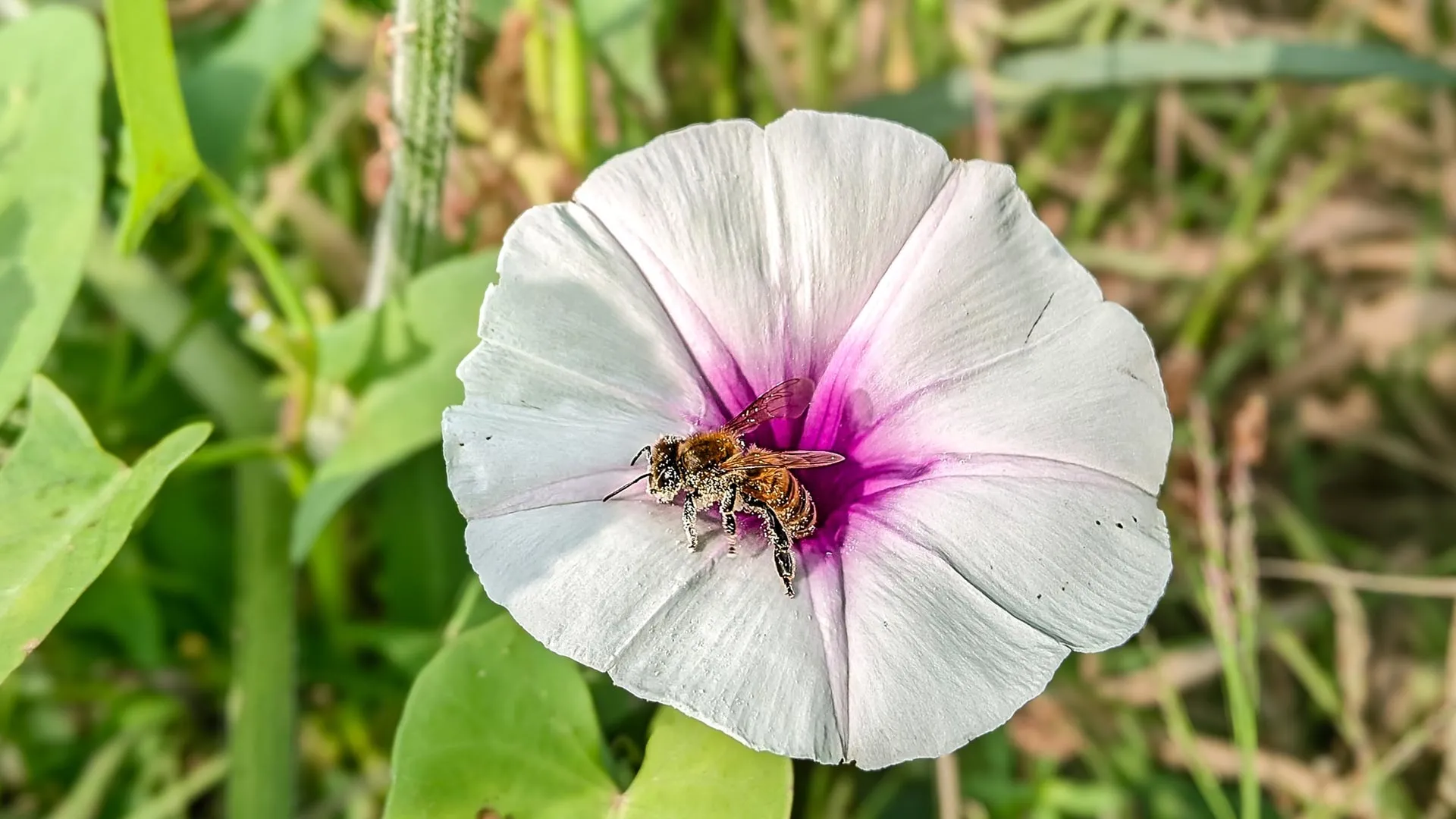
Plants facing both a warming climate and rapidly declining pollinator populations may be pulled in competing evolutionary directions. A University of Michigan study suggests that, instead of adapting primarily to climate pressures, some plants may be evolving traits that help them attract pollinators. In morning glories, researchers found that the population's rate of adaptation fell by 96% over nine years.
That sharp slowdown could also have implications for agriculture because morning glory is often considered a troublesome weed by farmers. "Because pollinator pressure strongly favors larger flowers, that linkage may limit how efficiently the population can respond to other selective pressures. Whether that ultimately makes the weed more or less of a problem for farmers is hard to predict -- and that unpredictability is itself part of the story," said Regina Baucom, a professor in the U-M Department of Ecology and Evolutionary Biology.
Larger Flowers May Come With an Evolutionary Cost Baucom says the slowdown appears to stem from a conflict between two potentially useful traits. Larger flowers may improve a plant's chances of attracting pollinators, while flowering earlier can help plants respond to changing environmental conditions. In the morning glory populations, those traits became increasingly linked.
That connection appears to restrict how freely the plants can adapt, with selection for larger flowers taking precedence over the potential benefit of earlier flowering. Importantly, the newer plant populations still contained substantial genetic variation. In theory, that diversity should provide enough raw material for continued adaptation.
"The plant isn't running out of evolutionary fuel -- it's increasingly locked into a trajectory that favors pollinator attraction, potentially at the expense of climate adaptation," Baucom said. The research was led by recent doctoral graduate Sasha Bishop in collaboration with University of Toronto researcher John Stinchcombe. The team studied morning glories as part of a broader effort to understand how human-caused global change is shaping evolution.
Climate warming is only one of the pressures plants and animals now face. Human development has replaced previously undisturbed habitat, while widespread agricultural use of pesticides and herbicides has contributed to major declines in pollinator populations. Bishop says the study, published in Evolution Letters, explores a growing mismatch between evolutionary theory and what researchers are observing in nature.
Extract — continue reading at the source.


