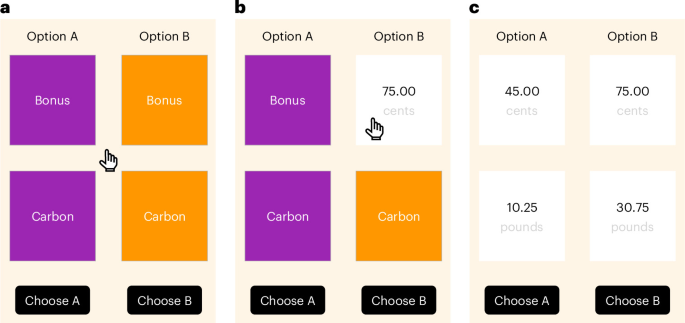
Political polarization and increasing exposure to extreme weather can shape public engagement with climate change, yet the underlying psychological mechanisms remain unclear. In this Registered Report, we examine how political affiliation, extreme weather exposure and subjective attribution influence climate-relevant information search and decision-making in a US sample (N = 1,451). We combined a process-tracing paradigm within an incentivized decision task involving real carbon emissions with objective data on extreme weather exposure.
Democrats attended more to carbon emission information and made more pro-climate choices than Republicans, with no evidence of moderation by objective extreme weather exposure. The subjective attribution of extreme weather to climate change was associated with greater attention to carbon information, more pro-climate choices and moderated the effects of exposure on both outcomes. These findings highlight the importance of political affiliation in climate-relevant decision-making and suggest that extreme weather effects depend less on exposure itself than on how these experiences are interpreted.
As extreme weather events become more intense and frequent with climate change1, the role of such events in shaping public awareness and prompting climate action has been a subject of considerable debate2,3,4. Researchers have proposed that these events may act as catalysts for capturing attention, raising awareness and spurring action to combat climate change5,6,7,8. While evidence suggests that extreme weather events can influence climate change engagement, this influence seems to depend on individual differences such as a person’s political affiliation6,9,10.
Especially in polarized political contexts such as in the USA, political affiliation may shape whether extreme weather is understood as evidence of climate change or dismissed as unrelated, thereby influencing how people seek and process climate-relevant information. Among the individual factors that shape responses to extreme weather, political affiliation is one of the strongest predictors of climate change beliefs11. Individuals aligned with more liberal (versus conservative) political parties are more likely to believe in climate change and to support climate-relevant behaviours and policies12,13,14, particularly in the USA14,15.
Despite extensive evidence linking political affiliation to climate beliefs and behaviours, much less is known about how it shapes the psychological processes through which people seek out, attend to and use climate-relevant information, particularly in the context of varying exposure to extreme weather events. These processes may include whether individuals notice and evaluate the carbon footprint of products before purchase, compare environmentally responsible investment opportunities or consider political candidates’ positions on climate action. Understanding how political affiliation influences these information-processing pathways may help explain why similar environmental experiences lead to different patterns of climate engagement and decision-making.
To address this gap, our study investigates how individual characteristics (that is, political affiliation) and physical-level determinants (for example, exposure to extreme weather) jointly shape climate-relevant information search and decision-making. In doing so, we respond to calls for climate-behaviour research that accounts for the variety, complexity and interconnectedness of behavioural determinants16,17. We use visual attention to climate-relevant information as an indicator of these underlying processes measured with a MouselabWEB paradigm, which allows us to examine how people allocate attention to may provide insights relevant to future research on communication strategies and policy measures aimed at fostering bipartisan engagement in climate action18,19.
Extract — continue reading at the source.


