Characterized by depression, anxiety, irritability, and fatigue, maternal perinatal distress influences infants’ neurodevelopment through biological and environmental pathways. The cerebellum is particularly vulnerable due to rapid growth and myelination after birth. While atypical cerebellar myelination is related to developmental impairments in children, its association with maternal distress remains unclear.
This study examined associations between postnatal anxiety and depression, neonatal cerebellar myelination, and neurodevelopmental outcomes at 18 months. Participants were recruited from St. Thomas’ Hospital in London, UK, and a sample of 291 mother-child dyads participated.
Maternal distress was assessed using the Edinburgh Prenatal/Postnatal Depression Scale (EPDS). Neonates underwent MRI between 0–5 weeks after birth, and T1- and T2-weighted images were acquired. T1w/T2w ratio was used to create a proxy of cerebellar myelination maps.
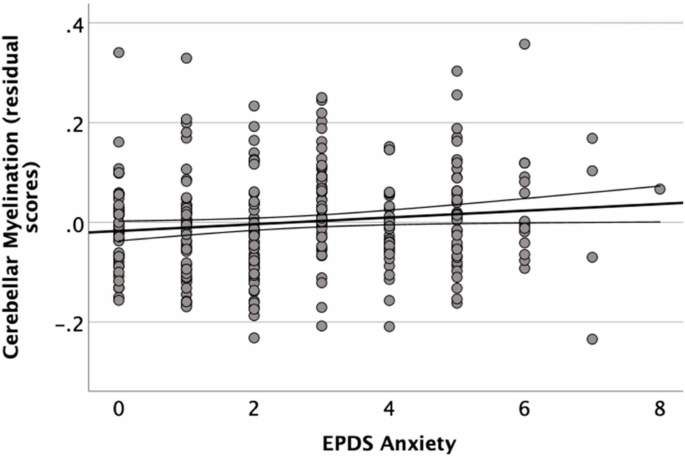
Neurodevelopmental outcomes were assessed with the Cognitive-, Language-, and Motor- scales of the Bayley Scales of Infant and Toddler Development, Third Edition. Anxiety symptoms were associated with increased Average T1w/T2w Ratio (proxy for myelination) (B = 0.009, 95% CI = 0.001 – 0.017, p = 0.024). In turn, average T1w/T2w Ratio was associated with lower receptive communication scores at 18 months (B = −5.02, 95% CI = −8.38 – −1.66, p =0.003).
Mediation analysis revealed a significant direct effect of anxiety symptoms on receptive communication (B = –0.19, SE = 0.096, p = 0.046) and a significant indirect effect through average T1w/T2w ratio (B = –0.032, 95% CI [–0.070, –0.0003]), indicating that average T1w/T2w ratio partially mediated the association between maternal perinatal/postnatal anxiety and receptive communication. These findings suggest that neonatal myelination may partially mediate the influence of maternal distress on infant outcomes, suggesting that maternal distress may, in part, shape the trajectory of cerebellar maturation and early neurodevelopment. This is a preview of subscription content, access via your institution Receive 12 print issues and online access Prices may be subject to local taxes which are calculated during checkout Data for this study are publicly available (https://www.developingconnectome.org/).
Tang X, Lu Z, Hu D, Zhong X. Influencing factors for prenatal stress, anxiety and depression in early pregnancy among women in Chongqing, China. J Affect Disord. 2019;253:292–302.
Extract — continue reading at the source.


