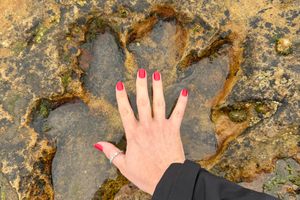
All the United Kingdom Scotland Prehistoric Crocodile Footprint Dating back roughly 240 million years to the Triassic period, it was left by a large, 12-foot-long crocodile ancestor called a Chirotherium or "hand-beast". The Chirotherium, a 12-foot-long crocodile-like reptile, left trails of footprints in four different locations on the Isle of Arran, Scotland, where it lived around 270 million years ago. Some of these footprints measure up to 40 centimetres long and feature large talons, making them the largest Chirotherium prints ever discovered on Earth.
At the time, Arran was part of the supercontinent Pangaea, and Chirotherium lived in a hot, arid climate near the sea. Get more unusual and extraordinary places each week with the Atlas Obscura Places newsletter. Your newsletter subscriptions with us are subject to Atlas Obscura's Privacy Policy and Terms of Use.
The prints are completely covered by the sea at high tide and are only safely accessible and visible when the tide goes out. The rocks can be slippery, wet, and covered in seaweed. The site of the fossilized remains of some of Earth’s earliest primitive, microbial life forms.
The museum within the Kom-Ombo Temple complex houses mummified crocodiles and mummified crocodile eggs. Giant steel and concrete dinosaurs near Route 66 invite passerbys into a mineral shop. A hidden Brooklyn basement gallery where two biologists nurture one of the Northeast’s rarest and most vibrant reptile collections.
One of the most intact and well-preserved skeletons of a mammoth in the world is displayed in a tiny Utah town. Anyone can play paleontologist at this quarry that has Cambrian fossils galore. ## Become an Atlas Obscura Member * * * Join our community of curious explorers. Become a Member Atlas Obscura uses cookies on its websites to personalize content and ads, to provide social media features, and to analyze our traffic.View Cookie Policy When you visit any website, it may store or retrieve information on your browser, mostly in the form of cookies.
This information might be about you, your preferences, or your device, and is mostly used to make the site work as you expect. The information does not usually identify you directly, but it can give you a more personalized web experience. Because we respect your right to privacy, you can choose not to allow some types of cookies.
Extract — continue reading at the source.
/https://tf-cmsv2-smithsonianmag-media.s3.amazonaws.com/filer_public/f6/c1/f6c13729-26b0-48eb-ba8c-9404f7b2ab3f/david_seman_1983631243.jpg)