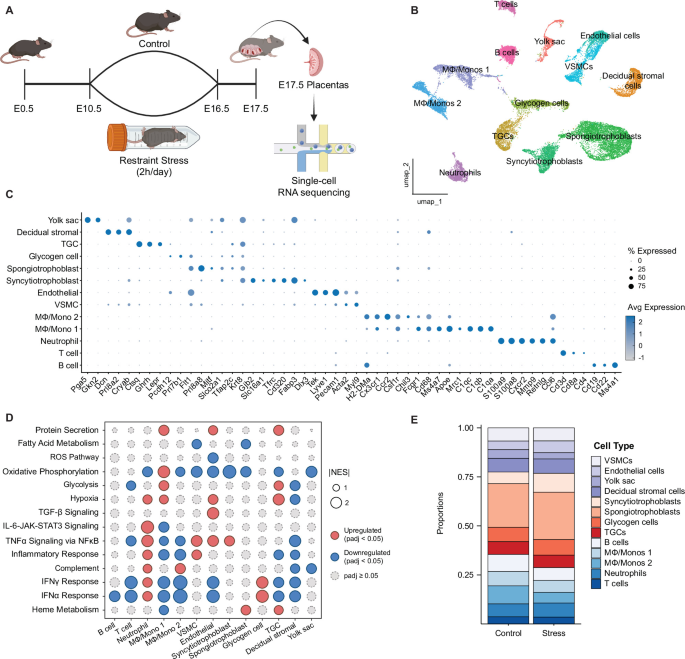
Prenatal psychosocial stress and maternal immune activation (MIA) increase risk for overlapping offspring psychiatric disorders, but whether they influence fetal neurodevelopment through shared or distinct mechanisms is unclear. Positioned at the interface of maternal and fetal physiology, the placenta has a critical role in regulating fetal brain development. Here, we combine mouse placental single-cell RNA sequencing, transcriptomics of matched placentas and fetal brains, maternal cytokine profiling, and human placental RNA-seq to dissect this axis.
In mice, chronic stress suppressed interferon signaling across placental immune cells and downregulated oxidative phosphorylation pathway expression in trophoblasts. Stressed dams also mounted a blunted type I interferon response to poly(I:C), resulting in attenuated placental antiviral signaling. Weighted gene co-expression analysis of fetal brains revealed that prenatal stress and MIA regulate overlapping DNA repair, synaptic, and translational networks in opposite directions, with stress promoting signatures of premature maturation and MIA driving replication stress.
In human placentas, higher perceived stress was associated with chromatin-regulatory, RNA-metabolic, and extracellular-matrix modules that mirrored the murine stress signature. These findings identify a conserved placental stress-associated transcriptional program and suggest that stress and MIA affect shared neurodevelopmental pathways in opposing directions. The placenta–brain axis is emerging as a key mediator linking maternal physiologic changes to fetal development [21].
The placenta integrates endocrine and immune cues, regulates metabolic and nutrient flux, and releases trophic factors that influence both maternal physiology and fetal brain maturation. Although our lab and others have shown that prenatal stress alters placental physiology [12, 14, 22, 23], the specific transcriptional pathways affected within individual placental cell types and the extent to which these changes correspond to coordinated transcriptional states in the fetal brain remain unresolved. It is also unknown whether prenatal stress and MIA engage shared placental mechanisms or impose distinct programs that drive specific disruptions to fetal brain gene networks.
Here, we address these gaps by integrating placental single-cell RNA sequencing, transcriptomics of matched placentas and fetal brains, and maternal cytokine profiling to map stress-induced alterations in the placenta–brain axis and determine how these signals integrate with, or diverge from, those induced by maternal immune activation. Prenatal stress dampens placental metabolic and antiviral signaling, creating a state of reduced reactivity that limits downstream responses to poly(I:C)-evoked immune challenge. Although prenatal stress and MIA can produce partially overlapping behavioral phenotypes, they elicit opposing transcriptional changes in fetal brain gene networks.
These results indicate that similar developmental outcomes may arise from distinct molecular trajectories that perturb the same developmental pathways in opposite directions. 10-week-old C57BL/6 nulliparous female mice from Jackson Lab (Bar Harbor, ME) were singly housed and acclimated to the vivarium for 1 week (light cycle 6am to 6 pm) prior to monogamous pairing with C57BL/6 males. Males were singly housed with cage enrichment. Females were checked daily for vaginal plugs, which was indicated as gestational day 0.5 (GD0.5).
Extract — continue reading at the source.


